One of my favorite lines in the Coen brothers' Miller's Crossing is when Jon Polito tells Albert Finney:
"I'm talkin' about friendship. I'm talkin' about character. I'm talkin' about - Hell, Leo, I ain't embarrassed to use the word - I'm talkin' about ethics."
Now this conversation digresses into a shady defense of betting and thrown fights, but it's still a great line, and it's been running through my head lately because ethics have been running through my head.
In particular, the ethics of the culture of egg donation.
Until recently, one of my main arguments against why I didn't want to use an egg donor (aside from the fact that I just didn't want to) was that I found it not that different from adoption, and I struggled with how the culture of egg donation dismissed one of the key lessons from the adoption world - one that changed it from sordid to inspiring.
I think it's useful to look at the history of adoption to get what I mean: way back when, the process began by smuggling loose girls into homes for 9 months until barren wives removed the pooping evidence of shame and falsely claimed the babies as their own, never telling the children about their origin. The result was that girls were forever disgraced, women lived in fear of being outed, and children were deceived throughout their lives.
Since then, the adoption community has worked hard to bring dignity to all parties' experiences. What that means in terms of child-rearing is that 99% of all adopted children are told they're adopted before age 5. Also 2/3 of all adoptions are open or semi-open, so that birthparents are known to the family, and children can potentially meet them. Kids are raised without deception, and if they turn out to be Emo navel gazers, they can go to the source to get their questions answered about their genetics and heritage. No lies. No secrets. Just ethics.
The egg donor world doesn't do that. About 80% of egg donors are anonymous (from what I've seen), and less than 25% of parents tell their kids that they're the product of egg donation (according to my clinic's therapist). And all I can think of when I see this is, What?
I know that it's a personal choice, but shit, dude, seems like kind of a bad choice to me. I mean, haven't we learned anything from the adoption world? The doctors seem to perpetuate anonymity (easier for them?), which then makes the the donors want to remain anonymous (denial about the gravity of what they're doing?), and couples are left with little choice but to build their families on secrecy.
So how is this affecting me? In my clinic's pool, there are 60 donors in the pool, and my criteria narrow it from there. In the end, I'm left with 1 donor. One. There's one donor that I like at my clinic, and she wants to remain completely anonymous.
Now what do I tell my kid when he says, "I'm talkin' about friendship. I'm talkin' about character. I'm talkin' about - Hell, Mom, I ain't embarrassed to use the word - I'm talkin' about ethics?"
Tuesday, September 20, 2011

Thursday, September 8, 2011
When Egg Substitute Is on the Shopping List
Selecting an egg donor is kind of a big deal. There are several categories of qualities to choose from, and before you even start looking, you pretty much have to accept that you can't have all of them, which - if you're a Type A personality who's delayed having a family until everything in your life is absolutely perfect, which you don't realize until you're completely infertile is never going to happen - is a hard thing to face.
There are a lot of qualities to choose from when hand-picking genes for your child, and if you have the impression that this process is a bizarre blend of Online Dating and science-fiction, then you understand the situation completely.
It's an extremely personal decision, and priorities will vary for everyone. After hours and days of profile searching, I determined what qualities I wanted. In order of importance, they are,
Health ties for first, or at least it runs a very close second. The available information ranges from serious birth defects to whether the donor ever had braces, and you get histories on the donor, her siblings (whole and half), her parents, and her grandparents. I have to admit that this area feels tricky since the information is volunteered and could easily be falsified, but what choice do I have? I'm being as picky as I can here and ruling out any genetic ailments, but lifestyle diseases (like adult onset diabetes) can slide.
Fertility comes in a very close third. There are only 3 ways to anticipate egg quality: the donor's age (the younger the better), previous pregnancies, and prior cycles. Proven donors charge about $2-3000 more than first-time donors, and I'm not prepared to add this to the cost just yet, which is what makes it come in third. Given that, I'm not considering anyone over 26 (the general cut-off is 30 or 32), and I'm looking for women who've had either children and abortions, but no miscarriages. The donor's resting follicle count is a 4th determinant of fertility, but you don't always get that information until after you've chosen her.
Intelligence runs a distant fourth for me. Lots of people prioritize intelligence, and I understand why. The brain is a physical organ that's inherited, so intelligence is obviously genetic. In fact, donors with medical degrees and Pulitzer-Prize-winning uncles go for about $25,000, so it's got to account for something. I, on the other hand, am just looking for a 3.0 GPA and the ability to communicate sensible thoughts. It's a low bar, but you can't prioritize everything, so I'm going to trust that N's brilliance will instill what it can into that baby, and we'll settle for nurture when it comes to the rest.
Personality-related information is, in my opinion, the most banal set of questions on these profiles. It includes things like favorite color, favorite book, and favorite movie, the last of which is invariably either Eat, Pray, Love or The Notebook (yes, they're that young). I'd never choose someone because we both like beach vacations, but I have eliminated tons of donors because their answers reveal that they're idiots, so I suppose that's useful.
Well, that's my list of priorities and the logic behind it. It makes perfect sense to me, but I also really understand why another person's list would look completely different.
OK. Now to find a match.
There are a lot of qualities to choose from when hand-picking genes for your child, and if you have the impression that this process is a bizarre blend of Online Dating and science-fiction, then you understand the situation completely.
It's an extremely personal decision, and priorities will vary for everyone. After hours and days of profile searching, I determined what qualities I wanted. In order of importance, they are,
- Looks
- Health
- Fertility
- Intelligence
- Personality
Health ties for first, or at least it runs a very close second. The available information ranges from serious birth defects to whether the donor ever had braces, and you get histories on the donor, her siblings (whole and half), her parents, and her grandparents. I have to admit that this area feels tricky since the information is volunteered and could easily be falsified, but what choice do I have? I'm being as picky as I can here and ruling out any genetic ailments, but lifestyle diseases (like adult onset diabetes) can slide.
Fertility comes in a very close third. There are only 3 ways to anticipate egg quality: the donor's age (the younger the better), previous pregnancies, and prior cycles. Proven donors charge about $2-3000 more than first-time donors, and I'm not prepared to add this to the cost just yet, which is what makes it come in third. Given that, I'm not considering anyone over 26 (the general cut-off is 30 or 32), and I'm looking for women who've had either children and abortions, but no miscarriages. The donor's resting follicle count is a 4th determinant of fertility, but you don't always get that information until after you've chosen her.
Intelligence runs a distant fourth for me. Lots of people prioritize intelligence, and I understand why. The brain is a physical organ that's inherited, so intelligence is obviously genetic. In fact, donors with medical degrees and Pulitzer-Prize-winning uncles go for about $25,000, so it's got to account for something. I, on the other hand, am just looking for a 3.0 GPA and the ability to communicate sensible thoughts. It's a low bar, but you can't prioritize everything, so I'm going to trust that N's brilliance will instill what it can into that baby, and we'll settle for nurture when it comes to the rest.
Personality-related information is, in my opinion, the most banal set of questions on these profiles. It includes things like favorite color, favorite book, and favorite movie, the last of which is invariably either Eat, Pray, Love or The Notebook (yes, they're that young). I'd never choose someone because we both like beach vacations, but I have eliminated tons of donors because their answers reveal that they're idiots, so I suppose that's useful.
Well, that's my list of priorities and the logic behind it. It makes perfect sense to me, but I also really understand why another person's list would look completely different.
OK. Now to find a match.
Monday, September 5, 2011
Online Dating: Egg Edition
By the time online dating came along, I was already several years into my relationship with N, so I was ever able to experience it. Until now.
My clinic's website has a convenient feature where I can easily search for the qualities and characteristics I'm looking for, and it couldn't be easier!
Eye color, hair color, race, education level: with a few easy clicks, the pool of available candidates is distilled to my taste. And once I've found a someone that I'd like to make babies with, I simply add her to my "Favorites" list.
Yes, it's that easy! And that creepy!
Let the match-making begin!!
Tuesday, August 30, 2011
Venngina Monologues
Everyone is telling me that using an egg donor for my IVF is almost no different from using my own egg. Their arguments go like this:
Friends: You're going to be the one to carry it for 9 months.
Doctor: It's just a genetic seed.
Scientist father-in-law: Current research shows that the embryonic environment is just as influential as genetics.
Husband: Uh...
Of all these, it's my husband who has the most insightful line of thinking because the truth is that, while there's validity to what the others are saying, the reality of egg donation is more complicated than that.
Part of the complexity is that the experience varies for each person dealing with it. For some people involved, it's closer to a natural conception, but for others, I think it's more like adoption.
To describe what I mean, I drew a continuum and plotted each player on the line: the mother, the father, the donor, and the kid.
To answer your questions in advance,
1) Yes, this is an odd thing to do.
2) No, I don't have any personal experience with any of this.
3) Yes, I'm just making this up as I go along.
OK, here goes.

For the father, having a child via egg donation isn't too different from own-egg IVF - assuming it's his sperm, that is. His wife is pregnant, and his parents' genetic lines are wholly represented in the kid. Yes, he lives in an egg donor home, but his genetic relationship to the kid is entirely traditional. Thus he's furthest on left.
For the donor, she's just aiding a couple who is having trouble conceiving, and it's a strictly medical procedure. The donor experiences no pregnancy, no labor, and no delivery, and she doesn't place a baby in another person's home, so the process is obviously very different from a birthmother's. On the other hand, she knows that the resulting children will be genetically hers. Throughout her life, she will wonder about them, and even though there won't be an emotional bond, curiosity will tickle just like it would for a birthmother. Because of all this, I've put her on the left, although not as far over as Pops.
For the child, the emotional experience will fall closer to the middle. Yes, his mother carried him, delivered him, and nursed him, but he won't remember any of that. All he knows is that he's genetically related to his father and not to his mother. Exactly how the kid will be affected by this depends on a million factors, but to some degree, when it comes to his mother, much of what he experiences will be similar to an adopted child: there will be a level of genetic loss, grief, and un-belonging. Near to the middle he goes.
For the mother, the experience really is a lot like adoption. After the pregnancy-delivery-nursing part is over, she'll have to face lots of the same things that adoptive moms do. Strangers will comment about how the kid looks nothing like her, and people will ask about the child's "real" mother. A bit of consolation is that her child is genetically related to his father, but that can also feel painful since Mom is the only one who can't experience that bond. For all these reasons, I'm putting her nearer to the right of the continuum.
Again, I've got no hard data to back this up, but I think it sounds really good.
During my philosophizing, I came to an epiphany, and while I don't like to wax feminist, I'm going to play the card: I think the reason this all gets whitewashed is that the boy doctors are running the show, and from the male perspective, it's not at all like adoption. As far as the docs are concerned, they're just swapping one egg for another. For the fathers, there's no genetic difference. And the egg donor's experience is supervised and contained by the doctor. It's understandable, then, why these folks view it the way they do.
But for the mothers and children, egg donation has more psychological, social, and emotional similarities to adoption than to any other form of family building. To illustrate this further, I drew a venn diagram laying out the overlap. (Again, yes, I'm weird for doing this. Just go with it.)
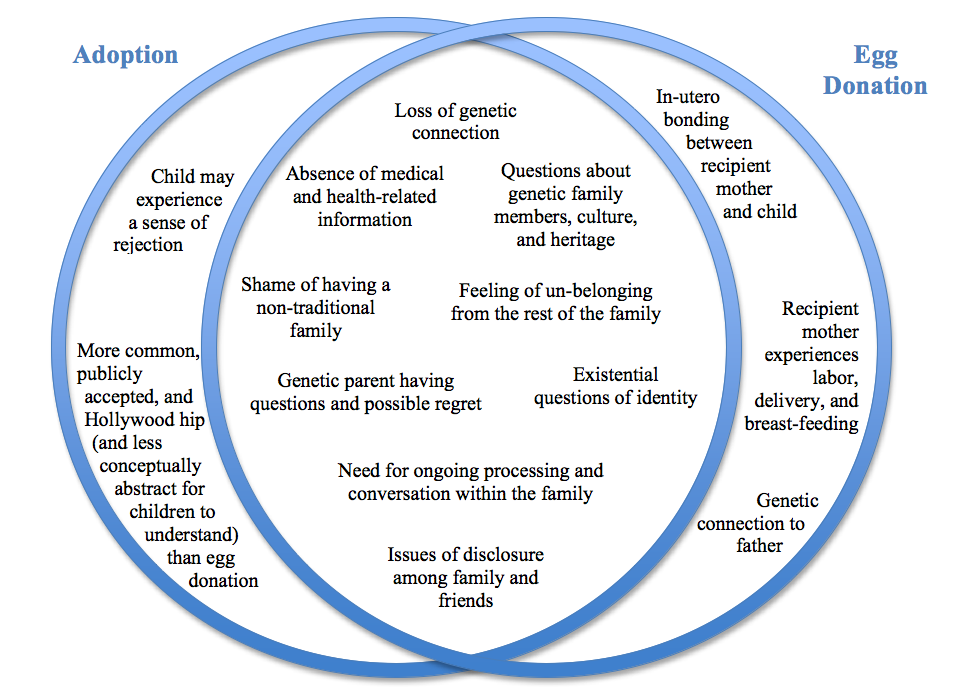
Sure, there are distinctions, and yes, there's a lot missing, but I still maintain that no matter how complete this diagram gets, the similarities between egg donation and adoption are greater than the differences.
Ultimately, I think this is a linguistics issue. It's called an "egg donor procedure," and it produces an "egg donor baby," but this language places all the focus on the doctors and the donors. Yes, she's donating, but I'm receiving, and these phrases don't say anything about my experience. Come to think of it, this woman isn't even donating; she's actually charging us several thousand dollars (which I think is fair considering all the time, effort, pain, and risks). In light of all this, I can't help but feel that "egg donation" is a misnomer.
This is an "egg adoption." Egg adoption is an all-around more accurate term, and calling it anything else undercuts the emotional, social, and practical realities of the mother-child relationship. If you ignore that egg adoption is philosophically truer, I think that will just make it harder in the future when the square peg doesn't fit into the round hole.
I need to think of this as egg adoption so I can prepare myself for what I might face when raising a child that isn't genetically related to me. The adoption community has worked hard to create a culture of openness, integrity, and normalcy, and it has a deep understanding of the social and psychological implications of the process. It's obviously not exactly the same, but I'd be crazy not to learn from them if I'm going to consider this.
Yup. I said it. I'm considering this.
Weird.
Friends: You're going to be the one to carry it for 9 months.
Doctor: It's just a genetic seed.
Scientist father-in-law: Current research shows that the embryonic environment is just as influential as genetics.
Husband: Uh...
Of all these, it's my husband who has the most insightful line of thinking because the truth is that, while there's validity to what the others are saying, the reality of egg donation is more complicated than that.
Part of the complexity is that the experience varies for each person dealing with it. For some people involved, it's closer to a natural conception, but for others, I think it's more like adoption.
To describe what I mean, I drew a continuum and plotted each player on the line: the mother, the father, the donor, and the kid.
To answer your questions in advance,
1) Yes, this is an odd thing to do.
2) No, I don't have any personal experience with any of this.
3) Yes, I'm just making this up as I go along.
OK, here goes.
For the father, having a child via egg donation isn't too different from own-egg IVF - assuming it's his sperm, that is. His wife is pregnant, and his parents' genetic lines are wholly represented in the kid. Yes, he lives in an egg donor home, but his genetic relationship to the kid is entirely traditional. Thus he's furthest on left.
For the donor, she's just aiding a couple who is having trouble conceiving, and it's a strictly medical procedure. The donor experiences no pregnancy, no labor, and no delivery, and she doesn't place a baby in another person's home, so the process is obviously very different from a birthmother's. On the other hand, she knows that the resulting children will be genetically hers. Throughout her life, she will wonder about them, and even though there won't be an emotional bond, curiosity will tickle just like it would for a birthmother. Because of all this, I've put her on the left, although not as far over as Pops.
For the child, the emotional experience will fall closer to the middle. Yes, his mother carried him, delivered him, and nursed him, but he won't remember any of that. All he knows is that he's genetically related to his father and not to his mother. Exactly how the kid will be affected by this depends on a million factors, but to some degree, when it comes to his mother, much of what he experiences will be similar to an adopted child: there will be a level of genetic loss, grief, and un-belonging. Near to the middle he goes.
For the mother, the experience really is a lot like adoption. After the pregnancy-delivery-nursing part is over, she'll have to face lots of the same things that adoptive moms do. Strangers will comment about how the kid looks nothing like her, and people will ask about the child's "real" mother. A bit of consolation is that her child is genetically related to his father, but that can also feel painful since Mom is the only one who can't experience that bond. For all these reasons, I'm putting her nearer to the right of the continuum.
Again, I've got no hard data to back this up, but I think it sounds really good.
During my philosophizing, I came to an epiphany, and while I don't like to wax feminist, I'm going to play the card: I think the reason this all gets whitewashed is that the boy doctors are running the show, and from the male perspective, it's not at all like adoption. As far as the docs are concerned, they're just swapping one egg for another. For the fathers, there's no genetic difference. And the egg donor's experience is supervised and contained by the doctor. It's understandable, then, why these folks view it the way they do.
But for the mothers and children, egg donation has more psychological, social, and emotional similarities to adoption than to any other form of family building. To illustrate this further, I drew a venn diagram laying out the overlap. (Again, yes, I'm weird for doing this. Just go with it.)
Sure, there are distinctions, and yes, there's a lot missing, but I still maintain that no matter how complete this diagram gets, the similarities between egg donation and adoption are greater than the differences.
Ultimately, I think this is a linguistics issue. It's called an "egg donor procedure," and it produces an "egg donor baby," but this language places all the focus on the doctors and the donors. Yes, she's donating, but I'm receiving, and these phrases don't say anything about my experience. Come to think of it, this woman isn't even donating; she's actually charging us several thousand dollars (which I think is fair considering all the time, effort, pain, and risks). In light of all this, I can't help but feel that "egg donation" is a misnomer.
This is an "egg adoption." Egg adoption is an all-around more accurate term, and calling it anything else undercuts the emotional, social, and practical realities of the mother-child relationship. If you ignore that egg adoption is philosophically truer, I think that will just make it harder in the future when the square peg doesn't fit into the round hole.
I need to think of this as egg adoption so I can prepare myself for what I might face when raising a child that isn't genetically related to me. The adoption community has worked hard to create a culture of openness, integrity, and normalcy, and it has a deep understanding of the social and psychological implications of the process. It's obviously not exactly the same, but I'd be crazy not to learn from them if I'm going to consider this.
Yup. I said it. I'm considering this.
Weird.
Tuesday, August 23, 2011
What My Astrologer Said
About a year after my chemical pregnancy and the depression that followed, I decided to give IVF a fourth and final try. And I had good reason to be optimistic about it: my astrologer said that this time it would work.
At my last chart reading, he laid it out in no uncertain terms: July 2011 was going to find me pregnant, and March 2012 would bring me a baby.
OK, so he might not have said it exactly like that. He might have said something more along the lines of, "July is going to be a good month for you, and so is March," but being that July and March were 9 months apart, and that "good" equals "pregnant," it was obvious what he meant.
Which is why I wasn't phased when the doctor said my chances of success were between 5 and 10 percent. Yes, those odds are low, but... well,... didn't you hear what my astrologer said?
On perfect schedule, we started stims in June. Great. But a few days in, my ultrasound showed only 3 follicles growing. Cycle cancelled.
Shit. What the hell would this mean?
I wondered if my astrologer meant "around July." Or, maybe I was actually born at 9:52 instead of 9:50, which would throw my whole chart off. In either case, it was obvious that I was supposed to have an August pregnancy. No, wait; I had to wait a cycle. So, September. Obviously.
Except that when I went in a couple weeks ago for my September suppression check, my doctor found cysts, which means I have to delay yet another month.
Clearly my ovaries didn't believe in astrology.
Nor does my doctor. I clung to my paper drape after the ultrasound and tried to explain to him that I was supposed to have a baby in March, and that my reproductive system was delaying things significantly. He shook off his confusion and responded as best he could: "If you want to become pregnant, your best bet is to use a donor egg. Nine months after you start a donor cycle, you'll have an 80% chance of taking home a baby."
In the moment that he said that, it didn't occur to me that he was making this prediction without having any idea what time I was born because... donor egg?
Friday, July 15, 2011
Un(en)titled
I don’t deserve this.
I don’t deserve my infertility or the years I spent struggling with the most complex grief I’ve ever known. God knows, there are worse tragedies in the world, but there’s something about the pain of infertility that is deepened by its inherently enduring hopefulness. It forbids you to let go. I spent over 4 years living in monthly anticipation that something good would happen. “Don’t give up,” it said. “There’s still one more thing to try.” So I hung on. And on. And on. And I didn’t deserve that.
I also didn't deserve my generous and loving family, the education I've had, or the summer camps I went to when I was young. I don’t deserve a nice house, the means to travel, or to eat out when I want. I don’t deserve a husband who is willing to work as hard as I am at making our relationship beautiful, nor do I deserve access to the therapy that helped us get here. I don’t deserve my above average intelligence, my great health, or a face that still gets me carded at 39. I don’t deserve a lifetime of good relationships, loads of dear friends, and (in case I haven’t mentioned) my incredible family.
I didn’t deserve any of these things because deservedness has nothing to do it. You get what you get. Some things are good; some things aren’t. That’s just the way it is.
It’s a simple truth, but it didn’t occur to me until now: I'm not entitled to fertility. Being unable to conceive at 35 was a stroke of bad luck, but considering the context of the rest of my life, it seems pretty fair. I am absurdly privileged, and there is no reason that I should be able to have children on top of all the embarrassing number of advantages that I've had – advantages for which I was never even been especially grateful.
Until infertility. Infertility mocked my expectations. After my first failed IVF, infertility made me stand in line behind a pregnant woman while I bought cat food. Infertility flooded my Facebook feed with chubby cheeks and onesies while I was bled out a miscarriage. It ridiculed my grief and was indifferent to my tears. It made me want and didn’t let me get. Infertility humbled me.
I didn’t deserve infertility, but it taught me to recognize and appreciate all the privileges I never earned. I am grateful for how it’s changed me, but I still won't say that I’m grateful for infertility itself, because for fuck’s sake, it hasn’t changed me that much.
Sunday, June 12, 2011
Down Dog, Up Dog
After my second IVF, I got mad at my body. After years and years of taking amazing care of it, I was repaid with infertility at an unreasonably early age. I felt betrayed that my body would do this to me. And I was pissed.
"Listen, You," I said to my body. "Your infertility is bullshit, and you deserve to be punished. Now, I know how much you love doing yoga, but I don't care about you right now. Not to mention, doing yoga makes me feel closer to you, and that makes me feel even more vulnerable, and I feel bad enough already, so... You're grounded: no more yoga."
The punishment stuck for about a year. Well, mostly. I would occasionally cave, but for the most part, I kept to my word. And it was good. Well, maybe not exactly good, but it was fine. OK, so, not entirely fine. I did spiral a bit. And I grieved. A lot. But whatever. I said no yoga, and I meant no yoga.
And I kept my word until a few months ago. By the end of 2010, the anger was getting exhausting, and I figured it was time for me and my body to make amends. Plus I wasn't working, and I needed something to do, so I did yoga. At first a little, and then some more, and within a couple months I was practicing 5-6 days a week.
And it changed my life.
It was unexpected; I really just stood on that mat every day because I didn't have anything else going on. And it wasn't immediate, either, but after about 4 months of daily down dogs, I was altered.
I remember reading this New York Times article a while back about how meditation changes the brain. I believed it, but I never imagined what it could have felt like. Granted yoga isn't meditation -- it's meditative, which isn't the same thing -- but still, my brain was different.
A teensy part of me feels like outlining all the incredible ways that my mindset shifted, but I'm not going to. It's not anything that can be explained, anyhow. It's more of a mood. A sensation. A kind of a filter. Or maybe it's losing a filter. In any case, I'm not going to describe it.
But, it's seriously awesome.
Subscribe to:
Posts (Atom)