Showing posts with label egg adoption. Show all posts

Monday, June 16, 2014

Fuck You, Katie Couric: A Love Story


For those of you living under a rock or some other place where no one gives a shit about egg donation, Katie Couric recently did a segment about a donor egg conceived child and her family who met their donor for the first time on her show. The program went as one might expect: some nervousness, lots of sweetness, and tons of positivity.
Afterwards, however, the tenor of the donor egg recipient community turned a vivid shade of fury because the language used on the show was different from the language we prefer. Whereas PVED uses "donor vs. biological mother" to differentiate the roles of the women, the people on Couric's show referred to the donor as the biological mother. Gasp.
The outrage went something like this: donors aren't mothers, and Katie Couric is an asshole.
Although I'm tempted to get into the weeds of the discussion, that would require too much tedium, so instead I'm just going to piss everyone off and say that I believe we're being overly sensitive, reactionary, and irrational because we're insecure about our roles as mothers.
Or at least that's true for me.
I've written my share of posts about language, and so I know all about the emotions that propel the fervor. Differentiating genetics from biology as if genes aren't a part of biology. Proclaiming that the donor is not a mother even though the entire history of science has a very clear definition of parent to the inclusion of the source of donated gametes.
Over the last few years, I've rallied against these truths, but all the while, something about my cries never sat right. Even in calm settings, these were never calm conversations. I tended to get a little worked up when talking about mine versus the donor's roles. Defensive. I always wore some layer of I-dare-you-to-challenge-my-legitimacy armor instead of admitting that "yes, as a factual matter of science, our donor is a biological mother to my child. Now how am I going to deal with how vulnerable that makes me feel?"
Because vulnerability is where this dogma comes from. Plain and simple, I'm afraid. I'm afraid that some people don't see me as the real mom. I lay awake wondering about the effects of my slow bonding process with my daughter and whether our relationship will suffer for it, or how much. I worry that she won't have enough of me in her, and she'll navel-gaze her way through adolescence until she ultimately disconnects from me completely. And if all of these questions didn't haunt me before, now I have to deal with them in the shadow of another mother.
But all of this is OK. I don't expose my fears to solicit comfort and validation, and I don't want your hugs. I don't want to feel better. I just want to feel.
It's important for me to sit with my grief. I cozy up to my sadness deliberately, and I make myself cry because I want to see my reflection in my tears. The more I feel the truth of my fears, the more quickly I can get through to the other side, even while the darkness makes me forget that another side exists.
I imagine that other donor egg recipients share some of the same vulnerabilities, and I imagine that some women are vulnerable in ways that are wholly different from me. I also imagine that some moms feel only a teensy amount of vulnerability and rarely think about their children's not uncomplicated (yes, that's a double negative) conception.
But I'll stop short of saying that any of us are 100% OK with the world of egg donation because I suspect that we all hang on to some degree of vulnerability. Even for those who are most at peace, at some point someone might say something that will trigger us, and suddenly we need to gouge out eyeballs, which - let's face it - is not the inclination of a person who's confident and secure.
Which brings me back to Katie Couric. As it did for most of my fellow egg donor recipients, the program challenged me. I almost didn't watch it ("biological mother? Come here so I can kill you."), but then I reflected on my resistance for long enough to muster up the courage, and I clicked play. I was nervous at the start, and as it went on, there were parts that definitely made me uncomfortable ("other grandmother?"). It wasn't easy, and it raised a lot of questions for me.
What if my daughter will want to meet her siblings? It's possible that she won't think about her genetic relatives, but it's also possible that she'll feel existentially incomplete until she gets to know this other part of her family. Will she want her donor in her life for milestones like graduations and her wedding, or will she need her around more often than that? And how in the world will I handle the threats of these possible futures without removing anyone's eyeballs?
But despite my emotional response, I can't deny that Couric did a pretty good job with the subject. She showed a healthy balance of curiosity and support, and she made her guests feel open and safe. Moreover, when all was said and done, I think the segment could potentially help normalize egg donation for people considering their family-building options. And maybe it even helped normalize egg donation for a certain someone who's already used it.
So fuck you, Katie Couric, for making me feel vulnerable. I hate you.
And thank you, Katie Couric, for making me feel vulnerable. I love you.

Thursday, December 29, 2011

Donor Down

Our donor fell through.

A woman who I've been thinking about for weeks and whom I've been affectionately calling #4889 has left us.

The clinic gave us two reasons. The first was that they discovered that she has a medical issue that is exacerbated by hormones, so she can't cycle (although they allowed her to finish her first). The other reason is that the staff doesn't want to work with her again because she's a bitch. Both seem reasonable.

Oddly, I miss her quite a lot. It's amazing how much of a bond is formed with a woman whom I was never going to meet. I'd been thinking so affectionately of her because she was going to be the gen-mom of my kids, and this made me love her in some way. Not quite as a friend, and not quite as family. It was something else.

When I got the news, I called N whose response was, "Good. Now we can choose a donor who's willing to have an open relationship."

I love him.

Sunday, November 27, 2011

Sophie's Choice, Reprise

I've been working hard to wrap my head around the ins-and-outs of what it'll mean to raise a child that isn't genetically my own. There are a lot of layers to it, especially since my discomfort stems from some deep-seated issues, but overall, I'd say I'm in a pretty good place with it.

But in rereading a post I wrote a few months back, there's something I said that still haunts me a little. In imagining a future fight with my DE child, I wrote:
When that child's pre-pubescent voice inevitably shouts, "You're not my real mom," my response will most definitely be, "Well, I never wanted you either, Kid."
(I'll give you a moment to close your dropped jaw.)

OK, so, yes, the idea that I might ever say something like that to a child is pretty horrifying, but what scares me a little now is that - even after all this time and therapy - there's still a grain of emotional truth in the sentiment.

Let me explain: It's not true that I won't want the kid himself. Of course I will. I've pretty much let go of any doubt that I won't bond with my DE children, or any children that I might be fortunate enough to raise.

What's true, however, is that I will have never wanted a situation where I couldn't have genetic children. Obviously I'd never want that. Who would? But that's different from "I don't want you." It's different enough that I no longer feel any reticence or reservation about pursuing donor egg IVF - but it's similar enough that I have to admit to still feeling a little scared.

What if my kid discovers how much I struggled with infertility? What if he feels like he wasn't my first choice of kids? I know what I'd say, of course. It'll be something along the lines of, "I'm glad I couldn't get pregnant on my own, because if I did, then I wouldn't have you, and there's no other kid in the world I'd want, blah, blah, blah." I worry, though, that there'll be a part of him that won't believe me, just like I worry that there's a part of me that doesn't believe me.

My self-consolation is this: I probably have about a decade before this imaginary fight comes up, and I can't know what things will be like until I get there. In the meantime, all I can do is trust what I do know: between therapy, my friends, my family, and (above all) N, I'm doing everything I can to be a responsible parent to a DE child, and my intention is to continue to do what's best for the children that I'm working so hard to manifest.

In the meantime, I'm still nervous about saying the absolute right thing to my kid, but at least I'm not nervous about saying the absolute wrong thing. Hopefully that's enough for now.

Friday, November 18, 2011

Case Study: Me

I've blogged about my theory that egg donation is not that different from adoption, and I've blogged about my negative feelings about adoption, and yet, I'm trying to adopt an egg. What gives?

Turns out I'm not the first person to have strong aversions to these things even while pursuing them, but there usually are reasons.

I know of one infertile woman who became pregnant with a donor egg baby, only to immediately regret doing it because she didn't feel bonded with the pregnancy. The root of her story was that she was physically abused by her father as a child, and her way of coping with the beatings was to tell herself, "at least we look alike, so I know he still loves me." She'd subconsciously learned that children must look like their parents for there to be love between them, and that's something she had to un-learn before she could bond with the baby she was carrying, which took some work, but she eventually did.

Then there's this other woman whose husband wanted to adopt even though she hated the idea. Turned out that it was her mother's recent passing that was the issue. Her sadness wasn't so much that the kid wouldn't have a genetic connection to her (although that was a part of it), but rather than the kid wouldn't have a genetic connection to her mom, and that loss was more than she'd prepared for. What she discovered was that she needed to grieve some more before being able to fill out adoption paperwork. She now has 2 adopted children, and she adores them both.

I have a story like this. In fact, I have two of them, but I'm not going to write about them here. There's a part of me that feels like I should because I want to justify things I've written in the past by sharing the traumas and vulnerabilities that made me into a person who would feel that way, but I can't do that here.

The point of all this is to say that I know I'm as messed up as anyone, and possibly more so. At best, I'm a work in progress. The good news, however, is that a part of this progress involves therapy to help me overcome the traumas that made it difficult for me to want to raise a child that I'm not genetically related to.

The other good news is that I'm getting there.

Tuesday, September 20, 2011

"I'm Talkin' about Ethics"

One of my favorite lines in the Coen brothers' Miller's Crossing is when Jon Polito tells Albert Finney:

"I'm talkin' about friendship. I'm talkin' about character. I'm talkin' about - Hell, Leo, I ain't embarrassed to use the word - I'm talkin' about ethics."

Now this conversation digresses into a shady defense of betting and thrown fights, but it's still a great line, and it's been running through my head lately because ethics have been running through my head.

In particular, the ethics of the culture of egg donation.

Until recently, one of my main arguments against why I didn't want to use an egg donor (aside from the fact that I just didn't want to) was that I found it not that different from adoption, and I struggled with how the culture of egg donation dismissed one of the key lessons from the adoption world - one that changed it from sordid to inspiring.

I think it's useful to look at the history of adoption to get what I mean: way back when, the process began by smuggling loose girls into homes for 9 months until barren wives removed the pooping evidence of shame and falsely claimed the babies as their own, never telling the children about their origin. The result was that girls were forever disgraced, women lived in fear of being outed, and children were deceived throughout their lives.

Since then, the adoption community has worked hard to bring dignity to all parties' experiences. What that means in terms of child-rearing is that 99% of all adopted children are told they're adopted before age 5. Also 2/3 of all adoptions are open or semi-open, so that birthparents are known to the family, and children can potentially meet them. Kids are raised without deception, and if they turn out to be Emo navel gazers, they can go to the source to get their questions answered about their genetics and heritage. No lies. No secrets. Just ethics.

The egg donor world doesn't do that. About 80% of egg donors are anonymous (from what I've seen), and less than 25% of parents tell their kids that they're the product of egg donation (according to my clinic's therapist). And all I can think of when I see this is, What?

I know that it's a personal choice, but shit, dude, seems like kind of a bad choice to me. I mean, haven't we learned anything from the adoption world? The doctors seem to perpetuate anonymity (easier for them?), which then makes the the donors want to remain anonymous (denial about the gravity of what they're doing?), and couples are left with little choice but to build their families on secrecy.

So how is this affecting me? In my clinic's pool, there are 60 donors in the pool, and my criteria narrow it from there. In the end, I'm left with 1 donor. One. There's one donor that I like at my clinic, and she wants to remain completely anonymous.

Now what do I tell my kid when he says, "I'm talkin' about friendship. I'm talkin' about character. I'm talkin' about - Hell, Mom, I ain't embarrassed to use the word - I'm talkin' about ethics?"

Tuesday, August 30, 2011

Venngina Monologues

Everyone is telling me that using an egg donor for my IVF is almost no different from using my own egg. Their arguments go like this:

Friends: You're going to be the one to carry it for 9 months.
Doctor: It's just a genetic seed.
Scientist father-in-law: Current research shows that the embryonic environment is just as influential as genetics.
Husband: Uh...

Of all these, it's my husband who has the most insightful line of thinking because the truth is that, while there's validity to what the others are saying, the reality of egg donation is more complicated than that.

Part of the complexity is that the experience varies for each person dealing with it. For some people involved, it's closer to a natural conception, but for others, I think it's more like adoption.

To describe what I mean, I drew a continuum and plotted each player on the line: the mother, the father, the donor, and the kid.

To answer your questions in advance,
1) Yes, this is an odd thing to do.
2) No, I don't have any personal experience with any of this.
3) Yes, I'm just making this up as I go along.

OK, here goes.


For the father, having a child via egg donation isn't too different from own-egg IVF - assuming it's his sperm, that is. His wife is pregnant, and his parents' genetic lines are wholly represented in the kid. Yes, he lives in an egg donor home, but his genetic relationship to the kid is entirely traditional. Thus he's furthest on left.

For the donor, she's just aiding a couple who is having trouble conceiving, and it's a strictly medical procedure. The donor experiences no pregnancy, no labor, and no delivery, and she doesn't place a baby in another person's home, so the process is obviously very different from a birthmother's. On the other hand, she knows that the resulting children will be genetically hers. Throughout her life, she will wonder about them, and even though there won't be an emotional bond, curiosity will tickle just like it would for a birthmother. Because of all this, I've put her on the left, although not as far over as Pops.

For the child, the emotional experience will fall closer to the middle. Yes, his mother carried him, delivered him, and nursed him, but he won't remember any of that. All he knows is that he's genetically related to his father and not to his mother. Exactly how the kid will be affected by this depends on a million factors, but to some degree, when it comes to his mother, much of what he experiences will be similar to an adopted child: there will be a level of genetic loss, grief, and un-belonging. Near to the middle he goes.

For the mother, the experience really is a lot like adoption. After the pregnancy-delivery-nursing part is over, she'll have to face lots of the same things that adoptive moms do. Strangers will comment about how the kid looks nothing like her, and people will ask about the child's "real" mother. A bit of consolation is that her child is genetically related to his father, but that can also feel painful since Mom is the only one who can't experience that bond. For all these reasons, I'm putting her nearer to the right of the continuum.

Again, I've got no hard data to back this up, but I think it sounds really good.

During my philosophizing, I came to an epiphany, and while I don't like to wax feminist, I'm going to play the card: I think the reason this all gets whitewashed is that the boy doctors are running the show, and from the male perspective, it's not at all like adoption. As far as the docs are concerned, they're just swapping one egg for another. For the fathers, there's no genetic difference. And the egg donor's experience is supervised and contained by the doctor. It's understandable, then, why these folks view it the way they do.

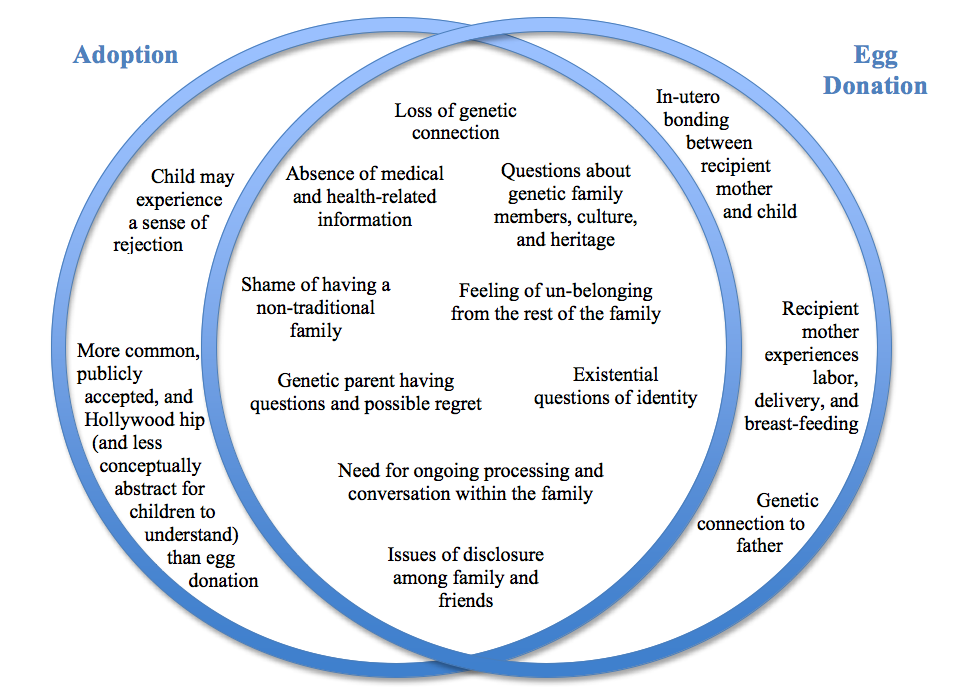
But for the mothers and children, egg donation has more psychological, social, and emotional similarities to adoption than to any other form of family building. To illustrate this further, I drew a venn diagram laying out the overlap. (Again, yes, I'm weird for doing this. Just go with it.)


Sure, there are distinctions, and yes, there's a lot missing, but I still maintain that no matter how complete this diagram gets, the similarities between egg donation and adoption are greater than the differences.

Ultimately, I think this is a linguistics issue. It's called an "egg donor procedure," and it produces an "egg donor baby," but this language places all the focus on the doctors and the donors. Yes, she's donating, but I'm receiving, and these phrases don't say anything about my experience. Come to think of it, this woman isn't even donating; she's actually charging us several thousand dollars (which I think is fair considering all the time, effort, pain, and risks). In light of all this, I can't help but feel that "egg donation" is a misnomer.

This is an "egg adoption." Egg adoption is an all-around more accurate term, and calling it anything else undercuts the emotional, social, and practical realities of the mother-child relationship. If you ignore that egg adoption is philosophically truer, I think that will just make it harder in the future when the square peg doesn't fit into the round hole.

I need to think of this as egg adoption so I can prepare myself for what I might face when raising a child that isn't genetically related to me. The adoption community has worked hard to create a culture of openness, integrity, and normalcy, and it has a deep understanding of the social and psychological implications of the process. It's obviously not exactly the same, but I'd be crazy not to learn from them if I'm going to consider this.

Yup. I said it. I'm considering this.

Weird.