Showing posts with label language. Show all posts

Monday, June 16, 2014

Fuck You, Katie Couric: A Love Story


For those of you living under a rock or some other place where no one gives a shit about egg donation, Katie Couric recently did a segment about a donor egg conceived child and her family who met their donor for the first time on her show. The program went as one might expect: some nervousness, lots of sweetness, and tons of positivity.
Afterwards, however, the tenor of the donor egg recipient community turned a vivid shade of fury because the language used on the show was different from the language we prefer. Whereas PVED uses "donor vs. biological mother" to differentiate the roles of the women, the people on Couric's show referred to the donor as the biological mother. Gasp.
The outrage went something like this: donors aren't mothers, and Katie Couric is an asshole.
Although I'm tempted to get into the weeds of the discussion, that would require too much tedium, so instead I'm just going to piss everyone off and say that I believe we're being overly sensitive, reactionary, and irrational because we're insecure about our roles as mothers.
Or at least that's true for me.
I've written my share of posts about language, and so I know all about the emotions that propel the fervor. Differentiating genetics from biology as if genes aren't a part of biology. Proclaiming that the donor is not a mother even though the entire history of science has a very clear definition of parent to the inclusion of the source of donated gametes.
Over the last few years, I've rallied against these truths, but all the while, something about my cries never sat right. Even in calm settings, these were never calm conversations. I tended to get a little worked up when talking about mine versus the donor's roles. Defensive. I always wore some layer of I-dare-you-to-challenge-my-legitimacy armor instead of admitting that "yes, as a factual matter of science, our donor is a biological mother to my child. Now how am I going to deal with how vulnerable that makes me feel?"
Because vulnerability is where this dogma comes from. Plain and simple, I'm afraid. I'm afraid that some people don't see me as the real mom. I lay awake wondering about the effects of my slow bonding process with my daughter and whether our relationship will suffer for it, or how much. I worry that she won't have enough of me in her, and she'll navel-gaze her way through adolescence until she ultimately disconnects from me completely. And if all of these questions didn't haunt me before, now I have to deal with them in the shadow of another mother.
But all of this is OK. I don't expose my fears to solicit comfort and validation, and I don't want your hugs. I don't want to feel better. I just want to feel.
It's important for me to sit with my grief. I cozy up to my sadness deliberately, and I make myself cry because I want to see my reflection in my tears. The more I feel the truth of my fears, the more quickly I can get through to the other side, even while the darkness makes me forget that another side exists.
I imagine that other donor egg recipients share some of the same vulnerabilities, and I imagine that some women are vulnerable in ways that are wholly different from me. I also imagine that some moms feel only a teensy amount of vulnerability and rarely think about their children's not uncomplicated (yes, that's a double negative) conception.
But I'll stop short of saying that any of us are 100% OK with the world of egg donation because I suspect that we all hang on to some degree of vulnerability. Even for those who are most at peace, at some point someone might say something that will trigger us, and suddenly we need to gouge out eyeballs, which - let's face it - is not the inclination of a person who's confident and secure.
Which brings me back to Katie Couric. As it did for most of my fellow egg donor recipients, the program challenged me. I almost didn't watch it ("biological mother? Come here so I can kill you."), but then I reflected on my resistance for long enough to muster up the courage, and I clicked play. I was nervous at the start, and as it went on, there were parts that definitely made me uncomfortable ("other grandmother?"). It wasn't easy, and it raised a lot of questions for me.
What if my daughter will want to meet her siblings? It's possible that she won't think about her genetic relatives, but it's also possible that she'll feel existentially incomplete until she gets to know this other part of her family. Will she want her donor in her life for milestones like graduations and her wedding, or will she need her around more often than that? And how in the world will I handle the threats of these possible futures without removing anyone's eyeballs?
But despite my emotional response, I can't deny that Couric did a pretty good job with the subject. She showed a healthy balance of curiosity and support, and she made her guests feel open and safe. Moreover, when all was said and done, I think the segment could potentially help normalize egg donation for people considering their family-building options. And maybe it even helped normalize egg donation for a certain someone who's already used it.
So fuck you, Katie Couric, for making me feel vulnerable. I hate you.
And thank you, Katie Couric, for making me feel vulnerable. I love you.

Friday, July 12, 2013

Battle of Wills


Here's a light-hearted query: who raises the kid if we both die?
Well, if we can hold off for a dozen or so years, then our friend JB would be perfect. I trust his values, his parenting skills, and his integrity, so he and his wife are the top pick. No problem.
But that's only if we don't die for a while -- if I get to raise the kid for a good chunk of time, and I leave behind a child who's old enough to have developed a longstanding consciousness about who I am. Under those circumstances, there'd be no problem.
On the other hand, if this death scenario goes down within the next couple years, then I do have a problem:
If we aren't genetically related, and I die shortly after giving birth, who would I be to this kid? If this baby originates from my donor and is parented by my friends, aren't I just the middle man? A carrier? A gestational surrogate? A biological host?
Short answer: yes.
If I die when the kid is a baby, and N isn't around either, then the child and I would have zero relationship. There'd be no fostered bond. There'd be no memories, no lasting love, and no connection that could be sustained. I'd have no more meaning to this kid than the donor would. Probably less.
And during those acne-ridden years of adolescent existentialism, staring back from that mirror would be the kid's father and donor. Not me.
And in going out into the world, there would be a life, a culture, and an environment constructed by new parents with stories and traditions that are entirely unrelated to me. Nothing of my heritage, my native language, or the flavors of my grandparents' foods. Nothing of my character, my personality, or my view of the world. Nothing of me.
In other words, both internally and externally, this kid would be built by Not Me. And by extension, I wouldn't be thought of by this kid as a parent.
Why would I be? Why should I be?
Out of love? Intention? Because it's what I would have wanted? That's not how kids' minds work. For children, those kinds of abstractions don't carry weight without a few years to cultivate a connection, and if I die when the kid is a tiny baby, ... seriously, ... I just won't have earned much value.
A conversational case in point:
The Kid: So, I have a genetic parent.
New Mom: The donor, yes.
The Kid: And you're the only mom I've ever known.
New Mom: I suppose.
The Kid: So why does it matter who carried me?
New Mom: Because she's the one who wanted you, who loved you before she ever knew you, and who did everything she could do finally have you and be your parent.
The Kid: But she doesn't know me. And she isn't my parent. And I wasn't around for any of that. And everyone in the world wants something, so why should I care about the wants of a dead person that I never knew?
New Mom: Good point, Kid. Want to go for ice cream?
The Kid: Sure, Mom.
See what I mean?
Which is why I'm gunning for the least rational custodial choice I can possibly make: if N and I orphan an infant, then I want the kid to go to my family.
Yes, my family of crazy people. Yes, the same family who - under normal circumstances - I wouldn't allow near my kid without a buffer. But given the choice between Real Mom and biological host, it's clear that those crazy people are the only way for me to edge my way into this kid's heart when I'm gone.
I want crazy people to raise my child because that's the only way to ensure that I'll be embedded in that kids life. Granted, there'll be sacrifices such as the absence of intellectualism, practicality, and true compassion. But no worries, because instead there'll be plenty of reactionary behavior, backward thinking, and emotional unsophistication.
But you know, that's how I was raised, and all I needed was a shitload of therapy, which brings me to the second stipulation in my will: besides naming crazy people as parents, I'll also require weekly therapy sessions. That way, the kid will be steeped in me; I'll surely be known no matter when I die, because fucked-up role-modeling and Gestalt therapy is as Me as it gets. Problem solved.
Except for that the problem isn't solved because my husband is never going to go for any of this, so a biological host I'll remain.
Fingers crossed that I don't croak too soon.
~~~
PS: I've disabled the comments section for this post because I'm entirely uninterested in
a lecture comments on this post.

Thursday, June 13, 2013

Therapy is Stupid


It's been months, and I still can't say it.
I can say, "I'm," and I can say, "pregnant," but so far I haven't managed to say them in sequence. Instead I default to, "I'm 14 weeks." Or to close friends I say, "I had a transfer at the end of March, and so far things are going well."
Or in the case of telling my parents, I just handed them my most recent ultrasound pictures, and I let them figure it out.
Unfortunately for me, my therapist picked up on my evasion the other day, and within minutes, she was trying to make me parrot her words: "I'm pregnant, and I'm scared."
She tried to make me say it, but she failed, and instead I spent the hour explaining to her why therapy is bullshit. I developed a very sound, four-pronged argument:
  1. The more I let myself feel, the harder I'll fall if something goes wrong, so denial is a sounder approach in this situation.
  2. If the Buddhist goal is to practice non-attachment, then isn't my way better?
  3. Why bother feeling one way or another if it won't change the outcome?
  4. I don't want to.
She had rebuttals.
  1. If I do end up "falling," then my denial will only make the fall harder. She argued that if something bad happens, then I'll have to process both the pregnancy and the pregnancy loss at the same time, and that would make the pain more profound.
  2. Non-attachment doesn't mean not feeling. Non-attachment means accepting the situation for what it is - including my feelings.
  3. It's true that feeling one way or another won't change the outcome, but it will inhibit the experience of a positive outcome. I can only feel as much joy as I can grief, so if I want to open my heart to happiness (and love and bonding), then I also have to open my heart to fear.
  4. Of course I don't want to. That's because I'm pregnant and I'm scared.
Ugh. Stupid therapy.

Thursday, December 20, 2012

Psychopathic Naturopathic Medicine


(Three posts in three days, I know. Shit's getting real.)
I've started seeing naturopaths. That's naturopaths plural. Meaning three of them.
My main naturopath says that the reason I can't carry a pregnancy is threefold: lack of circulation, elevated toxicity, and increased inflammation. To ameliorate those things, I am two weeks into abiding by the following protocol.
  1. Acupuncture. For full-body circulation and not just infertility. (Once a week.)
  2. Homeopathic Unda Numbered Compounds. If you're thinking "what the fuck," then we're on the same page. I'm not sure, but they seem to be magic medicine that's taken in a magical way. All I know for sure is that they taste like booze, which is the only good thing about them. That, and I like saying "unda." (Fifteen drops three time day, an hour away from food.)
  3. Pregnancy Prep Enzyme Pills. I actually used to take these a few years ago because the cross-eyed chick with the tattoos at my health food store recommended them. They didn't work. (Two pills twice a day away from food.)
  4. Curcumin Pills. I know what you're thinking. "Cumin," right? Well, you're wrong because they're made of turmeric. I'm taking them because turmeric apparently decreases inflammation. Doesn't seem to be working for folks in the Middle East, but what do I know? (Two pills twice a day away from food.)
  5. Abdominal Castor Oil Heat Packs. I used to do this, actually. Not on myself, because it's disgusting, but back when I was a massage therapist, I would use them on clients. You put a gross amount of castor oil on your stomach, place a disposable cloth on top, and apply a heat pack wrapped in plastic on the belly. It draws out icky stuff and makes nice poops. (Daily for 20 minutes.)
  6. Mayan Abdominal Massage. This is exactly what it sounds like: a Mayan Shaman created a massage that makes people pregnant. If you stopped reading after "Shaman," then you'll never know how badly I want to be your best friend. (Once or twice a month by the therapist. Daily on myself for 10 minutes.)
  7. The Anti-Inflammatory Diet. This means:
    No gluten
    No soy
    No dairy
    No nightshades
    No sugar or sweeteners
    No caffeine
    No alcohol
    (Forever, or until I kill myself.)
Of these seven dos and don'ts, it's the diet that's most impacting because it means I can't eat out, and this is a HUGE problem because restaurants are my hobby, my sport, and my most favorite thing that N and I do together. And if you're about to say that I can find a way around it, then you haven't thought it through.
Think I can get away with Mexican food if I order rice, beans, and corn chips with guacamole? Not if the rice is cooked with tomato, the beans have chili powder, and the guac has sour cream. Perhaps some sushi? Sure, as long as I stick to sashimi and plain white rice, since I can't have soy sauce, miso soup, or sushi rice (which is seasoned with sugar). Or maybe some breakfast? It's easy to modify a cheese omelet with a side of potatoes, toast, and coffee with cream, because all I have to do is order plain eggs. Problem solved.
Truth be told, at 2 weeks in, I'm starting to get used to it. Or, at least I've stopped crying about it (yes, literally). And I do feel better after I eat, so I suppose something's working. I am not happy about it, though.
But I mentioned that I'm seeing three naturopaths, so here's the scoop on that: the first doctor is the one overseeing my whole treatment, giving me my herbal meds, and doing my acupuncture. The second naturopath is the one doing the Mayan abdominal massage. And the third naturopath warrants some storytelling.
The third naturopath likes every bit of this protocol, but she feels it's not quite as insane as it could be, so I need to add three more things:
  1. Pregnancy Tea. Your basic raspberry leaf concoction. (Two or more cups a day.)
  2. Utrophin PMG. The main ingredient in these pills is bovine uterus, which means that they're pills made from a bovine's uterus, which means that I'm taking bovine uterus pills that are made from a bovine's uterus. (Two pills twice a day with food even though the thought of consuming bovine uterus makes me want to vomit.)
  3. Pelvic Floor Massage. How is a pelvic floor massage different from Mayan Abdominal Massage? Well, only one involves getting massaged inside my vagina. (Once a month.)
Allow me to elaborate on this last point, if you will. While others before me have paid good money to have their pussies rubbed, I never imagined that one of those people would be me. However, a friend of mine had it done after 2 years of trying to conceive on her own, and the month after her first treatment, she got pregnant. I don't think this will happen to me, but it also seems worth trying. Besides, it's something to blog about.
So, in conjunction with the adjustments that my doctor recommended, this is the Kitchen Sink Cycle. Although truth be told, it will probably more commonly be referred to as the Final Cycle, because it's official: after this, I'm done. And while I'm scared about what this might mean, it feels good to have made the decision. Infertility has taken up too much of my life and my body, and -- although I will continue to try and manifest a kid or two by other means -- I need to take my body out of the equation. Enough is enough.
In the meantime, I'm going to do everything the naturopaths tell me to do and hope that the pelvic floor massage will get me my happy ending.

Friday, February 10, 2012

Will the Real Mom Please Stand Up?

At some point, someone will ask me the single most upsetting question about my future kid's donor:
Do you ever wonder about the real mom?
Obviously the person asking will either be an idiot or an asshole, but either way I'll know what they're thinking, and that's precisely the problem.

We live in a culture where the definition of the "real parents" is in flux. It's traditionally understood that real parents are the people who you look like, and it takes a certain amount of work to undo that conditioning. In the meantime, insensitive comments like these make DE parents a tad upset.

For example, donor egg moms really, really, really don't like when egg donors are referred to as mothers of any sort, and phrases like "genetic mothers" can send folks into a tizzy. What they're reacting to makes sense, mind you. It's threatening to feel disconnected from your DE child (which is bound to happen because parent-child relationships are nuanced), and it's threatening to have your bond with your DE child devalued by people around you (which is bound to happen because people are idiots). In context, these moms' reactions are completely and entirely appropriate.
What I struggle with is that DE moms defend their legitimacy by saying things like "I carried him," "I gave birth to him," and other assertions of biological involvement. I get what they mean, but this argument makes me uncomfortable because it implies that mothers who didn't give birth to their children aren't as worthy of the "mom" title and - the inverse - that birthmothers and surrogates are. All of which is to say that I think pregnancy a flawed defense of motherhood, and my opinion is that we shouldn't use it.

As a community, our tact should be different. It's simply a matter of reinforcing what we know to be true: real parents are the parents who raise the children.

This approach is particularly important when we consider that we're a part of a broader community of women, men, and couples who've turned to donor eggs, donor sperm, surrogates, and adoption to help us complete our homes. Defining parenthood is a collective concern, and we should do it in a way that is as inclusive as possible of these diverse family make-ups.

Personally, (as I've mentioned before) I don't feel threatened by having my donor referred to as the genetic mother. She is the genetic mother, and I'm the biological mother. That's the situation, and I'm not afraid to name it.

The problem would be if you say anything about her being the real mother, at which point I'm also not afraid to mother-fuck you up.

Thursday, February 2, 2012

Bio. Genetics.

After searching, downloading, and listening to every single NPR segment about egg and sperm donation they had, something occurred to me:

Women who use DS to conceive call their donors biological fathers.
Women who use DE to conceive never call their donors biological mothers. Ever.

This made me think about the words "biology," "genetics," and "biogenetics" and how this language reflects the reproductive roles of women and men.

To review how men make babies: they have sex (biology) and deposit sperm inside the woman (genetics). That's it. Their entire biogenetic function is tied to a single act that takes a few minutes. (Yes, boys, I said a few minutes).

For women, it's different. Women make babies through ovulation (genetic) but also through 9 months of gestation, 12-24 hours of labor, and another year of nursing (biology). So unlike men where the biogenetic experience is singular, women can actually separate out those two parts so that there are unique biological and genetic experiences in the baby-making process.

The implications of reproductive function on the language is the following (yes, it's another chart).


Again, I just make this shit up as I go along, but I think it sounds good.

Even though I'm convinced of these words' proper usages, I've caught myself mixing them up; I sometimes say that my kid won't be biologically mine when what I mean is genetic. I know why I slip up: it's because this whole thing is some crazy sci-fi shit, and it's not easy to wrap my head around.

The silver lining, though, is that it'll be confusing for others, and I'll get to mess with them by introducing conversations about the linguistic implications of reproductive technologies and their effects on popular understandings of biogenetics.

That'll be fun.

Tuesday, August 30, 2011

Venngina Monologues

Everyone is telling me that using an egg donor for my IVF is almost no different from using my own egg. Their arguments go like this:

Friends: You're going to be the one to carry it for 9 months.
Doctor: It's just a genetic seed.
Scientist father-in-law: Current research shows that the embryonic environment is just as influential as genetics.
Husband: Uh...

Of all these, it's my husband who has the most insightful line of thinking because the truth is that, while there's validity to what the others are saying, the reality of egg donation is more complicated than that.

Part of the complexity is that the experience varies for each person dealing with it. For some people involved, it's closer to a natural conception, but for others, I think it's more like adoption.

To describe what I mean, I drew a continuum and plotted each player on the line: the mother, the father, the donor, and the kid.

To answer your questions in advance,
1) Yes, this is an odd thing to do.
2) No, I don't have any personal experience with any of this.
3) Yes, I'm just making this up as I go along.

OK, here goes.


For the father, having a child via egg donation isn't too different from own-egg IVF - assuming it's his sperm, that is. His wife is pregnant, and his parents' genetic lines are wholly represented in the kid. Yes, he lives in an egg donor home, but his genetic relationship to the kid is entirely traditional. Thus he's furthest on left.

For the donor, she's just aiding a couple who is having trouble conceiving, and it's a strictly medical procedure. The donor experiences no pregnancy, no labor, and no delivery, and she doesn't place a baby in another person's home, so the process is obviously very different from a birthmother's. On the other hand, she knows that the resulting children will be genetically hers. Throughout her life, she will wonder about them, and even though there won't be an emotional bond, curiosity will tickle just like it would for a birthmother. Because of all this, I've put her on the left, although not as far over as Pops.

For the child, the emotional experience will fall closer to the middle. Yes, his mother carried him, delivered him, and nursed him, but he won't remember any of that. All he knows is that he's genetically related to his father and not to his mother. Exactly how the kid will be affected by this depends on a million factors, but to some degree, when it comes to his mother, much of what he experiences will be similar to an adopted child: there will be a level of genetic loss, grief, and un-belonging. Near to the middle he goes.

For the mother, the experience really is a lot like adoption. After the pregnancy-delivery-nursing part is over, she'll have to face lots of the same things that adoptive moms do. Strangers will comment about how the kid looks nothing like her, and people will ask about the child's "real" mother. A bit of consolation is that her child is genetically related to his father, but that can also feel painful since Mom is the only one who can't experience that bond. For all these reasons, I'm putting her nearer to the right of the continuum.

Again, I've got no hard data to back this up, but I think it sounds really good.

During my philosophizing, I came to an epiphany, and while I don't like to wax feminist, I'm going to play the card: I think the reason this all gets whitewashed is that the boy doctors are running the show, and from the male perspective, it's not at all like adoption. As far as the docs are concerned, they're just swapping one egg for another. For the fathers, there's no genetic difference. And the egg donor's experience is supervised and contained by the doctor. It's understandable, then, why these folks view it the way they do.

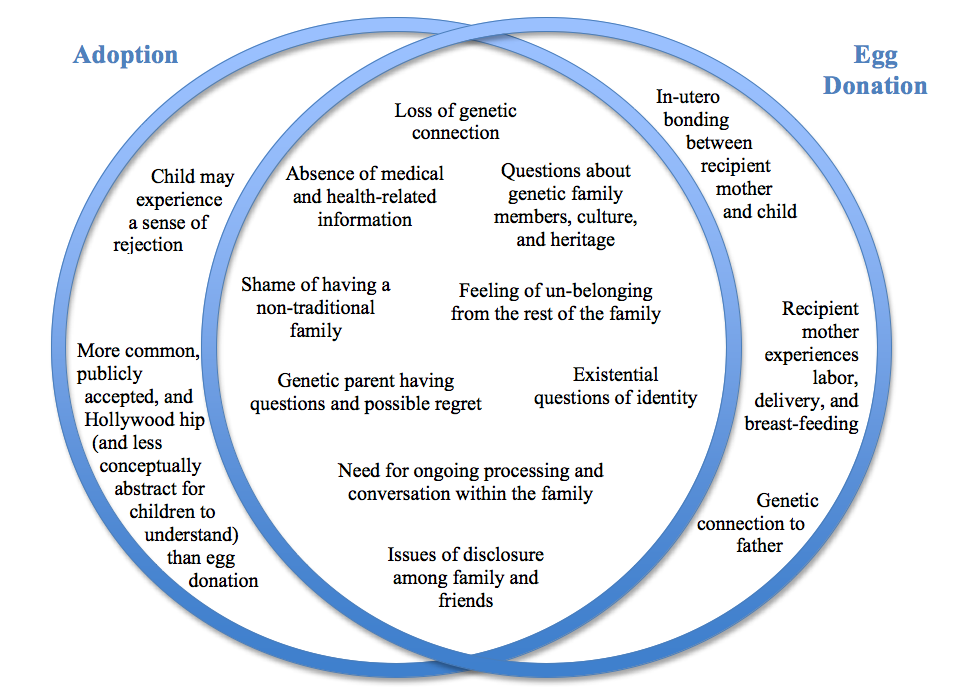
But for the mothers and children, egg donation has more psychological, social, and emotional similarities to adoption than to any other form of family building. To illustrate this further, I drew a venn diagram laying out the overlap. (Again, yes, I'm weird for doing this. Just go with it.)


Sure, there are distinctions, and yes, there's a lot missing, but I still maintain that no matter how complete this diagram gets, the similarities between egg donation and adoption are greater than the differences.

Ultimately, I think this is a linguistics issue. It's called an "egg donor procedure," and it produces an "egg donor baby," but this language places all the focus on the doctors and the donors. Yes, she's donating, but I'm receiving, and these phrases don't say anything about my experience. Come to think of it, this woman isn't even donating; she's actually charging us several thousand dollars (which I think is fair considering all the time, effort, pain, and risks). In light of all this, I can't help but feel that "egg donation" is a misnomer.

This is an "egg adoption." Egg adoption is an all-around more accurate term, and calling it anything else undercuts the emotional, social, and practical realities of the mother-child relationship. If you ignore that egg adoption is philosophically truer, I think that will just make it harder in the future when the square peg doesn't fit into the round hole.

I need to think of this as egg adoption so I can prepare myself for what I might face when raising a child that isn't genetically related to me. The adoption community has worked hard to create a culture of openness, integrity, and normalcy, and it has a deep understanding of the social and psychological implications of the process. It's obviously not exactly the same, but I'd be crazy not to learn from them if I'm going to consider this.

Yup. I said it. I'm considering this.

Weird.