Showing posts with label therapy. Show all posts

Tuesday, May 20, 2014

Gray Matters


You know the feeling: you're starving, and you really want a burger, but all you have is salad, so you eat the salad, and technically you aren't hungry anymore because the salad was huge and had lots of avocado and sunflower seeds and stuff like that, but it wasn't a burger, so you aren't fully satisfied.
I spoke to a friend today who asked for the lowdown on how it feels to be the mom of a donor egg baby. Is it everything that it promises to be? Is it worth the financial cost, the emotional roller coaster of hope-turned-grief, and the risk of having yet another miscarriage? Or should she consider moving forward with her life and live child-free.
She wanted an honest answer, so I gave it to her. It's kind of like a salad. It's good, but what I really wanted was a burger. And I'm not fully satisfied.
I'm not sure who these women are who say that a donor egg baby is the same as an own-egg baby. That they never think about the donor again after getting a pee-stick positive, seeing the heartbeat, feeling a kick, or whatever other milestone is met. I guess these women exist because boundless baby bliss is all I ever heard about; all I know is that I'm not one of them.
I think about the donor all the time. She's who I see when I look at my daughter's smile or wonder how I'm going to tame those crazy eyebrows. She's the person I think about when my husband talks about the family that we've built. She's what comes to mind when I see that my kid should have met some developmental skill and I wonder what consequences there'll be from being deceived about my donor's smarts on her profile.
This haunting motivated me to meet today with a therapist who specializes in infertility and third-party reproduction. I love my long-time therapist, but I'm not sure if she can help me with what I'm going through. As I mentioned in my last post, when I asked her why I'm feeling disconnected, she said that the why didn't matter and that I just needed to work on connecting with my kid. You know: "process my intimacy issues."
She's wrong, I think. I think it does matter. If I'm uneasy about qualities in my donor that I see in my daughter, I need to work through that. If my involvement in the donor egg community is making me think too much about my baby's conception, then I need to find a new distance with that world while still respecting whatever responsibility I owe my daughter. If there remains a shit ton of grief at the loss of my genetics, then I need to resolve that, too. And yes, process my intimacy issues blah blah fuck you.
So was my baby pursuit worth it in the end? I think so, but it's not exactly black and white. Raising my daughter is a thousand times better for me than being childless, but it hasn't been easy. She isn't a burger, but she is pretty damn good, and what I hope is that this work will turn these salad days into salad days.

Wednesday, May 14, 2014

Eat, Play, Love


Eat.
I have video footage of my baby crying while nursing my left tit because I have almost no milk. She had better luck on the right, but not much. I won't go into the details of how awful breastfeeding has been, but suffice it to say that it's been both physically and emotionally painful for both me and my kid.
Now at 5 months, she's almost exclusively formula fed. I have one last bottle of breast milk left, and I think I'll cry when I feed it to her. The few successful breastfeedings were profoundly sweet. In those moments, I felt like a mom. But still, quitting will be a relief. But also sad. But also a relief.

Play.
The truth is that I don't know how to interact with infants. Don't get me wrong: I took great care of her and held her almost constantly when she was teeny tiny, but infants are incredibly stupid, and playing with an infant isn't much different from playing with a bale of hay. You get about as much reciprocity: no eye contact and none of that cuddling that you imagine happens between mother and child. I tried to play with her as best I could, but really she was just a lot of noise and shitty diapers.
This changed over the last couple of months, and the 5-month mark was a special turning point. She laughs freely now, and it's easy to get her to smile. We spend a lot of time dancing around and roughhousing; she likes getting thrown in the air, getting tickled, and when I fling her upside-down. Sometimes our games make her throw up, but bales of hay don't throw up, so we're moving in the right direction. And I'm having fun.

Love.
For these and other reasons (hello, 5 hours of sleep!), parenting has gotten easier, but to be honest, there remains a bit of discord in our relationship: I'm not sure if I'm fully bonded with my kid, and I can't help but feel that it's because of the egg donation thing.
I don't know how parental love is supposed to feel, and maybe this is it. You hear about rainbows and unicorns popping out of women's vaginas together with their spawn, and all that came with my baby was blood and slime, so it's hard for me to tell.
It's possible that this emotional barrier is just a part of my psychology because of my broken upbringing. My childhood had a good bit of neglect and some physical abuse, so I might feel this way no matter how my child came about. I tried to flesh it out in therapy, but when I asked my therapist why I was feeling this lack of connection, she said that the why didn't matter and that I just needed to work on increasing my capacity for intimacy. (Intimacy issues? That's real original, Therapy. You fucking whore.)
I do really like spending time with the kid, but as often as not, I look at her like I'm not sure who she is. But maybe that's normal. Or maybe it's not. What the hell do I know? I still can't believe that the hospital let me take her home, to be honest. I mean, they don't even know me.
Hell. I don't know me.

Thursday, January 30, 2014

You Came Out of My Vagina


You came out of my vagina, but that's not when our story began.
Seven months before you came out of my vagina, I got a positive pregnancy test on the day my grandmother died, and I hoped this time I was really pregnant so that my dad (your granddad? weird.) could get some cheery news. Also, it would make me happy. I guess. Yes, of course it would. Happy. Obviously.
Five months before you came out of my vagina, I saw you on an ultrasound and found out you're a girl. Bummer. I don't like girls. Don't get me wrong: I like women; I just find little girls to be annoying as shit - all that squealing and crying and frilly pink shit. It's so much easier to deal with boys' broken bones than girls' broken hearts. But hopefully you'll be an athlete or a lesbian or into cool music, and you'll hate pink, too.
Three months before you came out of my vagina, I was scheduled for another ultrasound to get a better picture of your hands because so far it looks like you have no fingers, and I don't know if I can love a kid with hand stumps. But no matter what the ultrasound shows, 50% of you comes from your dad's genetics, so I'd be stuck with you. I wondered if this would be different if you were also 50% me, and this is when it becomes clear that I may not have been the best candidate for using a donor's egg.
One month before you came out of my vagina, conversations with your dad go something like this: But what if I don't love her? Don't worry; you will. But what if I don't? I know you; you will. But what if I don't? Stop over-thinking it; you will. But what if I don't? Etc. etc. etc. You can see why this is a problem, right?
The day you came out of my vagina, labor was short, and during the last few minutes, I wondered whether I could stop pushing and change my mind about the whole thing, but there were all these people around me saying things like "you're almost there" and "I can see her head," so I plowed forth.
You were a gross, slimy, wrinkly thing.
When it was over, a gross, slimy, wrinkly thing was handed to me, and I asked, "is this her?" Considering that the other end of your umbilical cord was still inside me, it should have been obvious that I wasn't looking for an answer from the nurse as much as I was looking for an answer from myself.
"Is this her?" meant "Is this it?" It meant is this really happening and did seven years of wanting a baby just come to an end? It meant who will I be as a mom and who will you be as a daughter and what will we be to each other?
It meant that I really wished someone would help me figure out a game plan for what to do if I don't love you.
During the first couple weeks after you came out of my vagina, you wouldn't look at me. You just peed and cried and ate and slept and shit. No eye contact whatsoever, which - frankly - wasn't a great way to get started on your part, now was it? As it was, what with our lack of genetic connection, how did you think we could build a relationship if you wouldn't even look at me?
It was during this period that your dad asked me if I loved you. I said I didn't know yet, which upset him. I guess he thought that the reality of your existence would melt my heart, but he overestimated my capacity to adore people that come out of my vagina.
I felt fiercely protective of you, though. I got pissed when you were left unattended on the changing table for a millisecond as if you could somehow leap to your demise at 2 days old. I woke up several times a night in a panic that you'd been scratched or had a fever or died from SIDS. And every time I picked you up, I was terrified that I'd trip and fall and smash your tiny skull into a wall. My every moment was riddled with anxiety that something awful would happen to you, and that with that, my world would crumble. But anxiety is not the same as love.
You looking at me.
And then some time later, you looked at me. Not a passing glance with untamed eyeballs, but actual eye contact. And that's when I thought, "Oh, hi, baby. How nice to meet you."
Was it love? Well, let's not get crazy. I mean, we don't really know each other yet, and one can't rush into things like this.
But you came out of my vagina, and a little while after that, we met. And now that we have, and our story has begun, it's possible that I'll love you after all.
And as it turns out, you look seriously fucking cute in pink.

Friday, July 12, 2013

Battle of Wills


Here's a light-hearted query: who raises the kid if we both die?
Well, if we can hold off for a dozen or so years, then our friend JB would be perfect. I trust his values, his parenting skills, and his integrity, so he and his wife are the top pick. No problem.
But that's only if we don't die for a while -- if I get to raise the kid for a good chunk of time, and I leave behind a child who's old enough to have developed a longstanding consciousness about who I am. Under those circumstances, there'd be no problem.
On the other hand, if this death scenario goes down within the next couple years, then I do have a problem:
If we aren't genetically related, and I die shortly after giving birth, who would I be to this kid? If this baby originates from my donor and is parented by my friends, aren't I just the middle man? A carrier? A gestational surrogate? A biological host?
Short answer: yes.
If I die when the kid is a baby, and N isn't around either, then the child and I would have zero relationship. There'd be no fostered bond. There'd be no memories, no lasting love, and no connection that could be sustained. I'd have no more meaning to this kid than the donor would. Probably less.
And during those acne-ridden years of adolescent existentialism, staring back from that mirror would be the kid's father and donor. Not me.
And in going out into the world, there would be a life, a culture, and an environment constructed by new parents with stories and traditions that are entirely unrelated to me. Nothing of my heritage, my native language, or the flavors of my grandparents' foods. Nothing of my character, my personality, or my view of the world. Nothing of me.
In other words, both internally and externally, this kid would be built by Not Me. And by extension, I wouldn't be thought of by this kid as a parent.
Why would I be? Why should I be?
Out of love? Intention? Because it's what I would have wanted? That's not how kids' minds work. For children, those kinds of abstractions don't carry weight without a few years to cultivate a connection, and if I die when the kid is a tiny baby, ... seriously, ... I just won't have earned much value.
A conversational case in point:
The Kid: So, I have a genetic parent.
New Mom: The donor, yes.
The Kid: And you're the only mom I've ever known.
New Mom: I suppose.
The Kid: So why does it matter who carried me?
New Mom: Because she's the one who wanted you, who loved you before she ever knew you, and who did everything she could do finally have you and be your parent.
The Kid: But she doesn't know me. And she isn't my parent. And I wasn't around for any of that. And everyone in the world wants something, so why should I care about the wants of a dead person that I never knew?
New Mom: Good point, Kid. Want to go for ice cream?
The Kid: Sure, Mom.
See what I mean?
Which is why I'm gunning for the least rational custodial choice I can possibly make: if N and I orphan an infant, then I want the kid to go to my family.
Yes, my family of crazy people. Yes, the same family who - under normal circumstances - I wouldn't allow near my kid without a buffer. But given the choice between Real Mom and biological host, it's clear that those crazy people are the only way for me to edge my way into this kid's heart when I'm gone.
I want crazy people to raise my child because that's the only way to ensure that I'll be embedded in that kids life. Granted, there'll be sacrifices such as the absence of intellectualism, practicality, and true compassion. But no worries, because instead there'll be plenty of reactionary behavior, backward thinking, and emotional unsophistication.
But you know, that's how I was raised, and all I needed was a shitload of therapy, which brings me to the second stipulation in my will: besides naming crazy people as parents, I'll also require weekly therapy sessions. That way, the kid will be steeped in me; I'll surely be known no matter when I die, because fucked-up role-modeling and Gestalt therapy is as Me as it gets. Problem solved.
Except for that the problem isn't solved because my husband is never going to go for any of this, so a biological host I'll remain.
Fingers crossed that I don't croak too soon.
~~~
PS: I've disabled the comments section for this post because I'm entirely uninterested in
a lecture comments on this post.

Thursday, June 13, 2013

Therapy is Stupid


It's been months, and I still can't say it.
I can say, "I'm," and I can say, "pregnant," but so far I haven't managed to say them in sequence. Instead I default to, "I'm 14 weeks." Or to close friends I say, "I had a transfer at the end of March, and so far things are going well."
Or in the case of telling my parents, I just handed them my most recent ultrasound pictures, and I let them figure it out.
Unfortunately for me, my therapist picked up on my evasion the other day, and within minutes, she was trying to make me parrot her words: "I'm pregnant, and I'm scared."
She tried to make me say it, but she failed, and instead I spent the hour explaining to her why therapy is bullshit. I developed a very sound, four-pronged argument:
  1. The more I let myself feel, the harder I'll fall if something goes wrong, so denial is a sounder approach in this situation.
  2. If the Buddhist goal is to practice non-attachment, then isn't my way better?
  3. Why bother feeling one way or another if it won't change the outcome?
  4. I don't want to.
She had rebuttals.
  1. If I do end up "falling," then my denial will only make the fall harder. She argued that if something bad happens, then I'll have to process both the pregnancy and the pregnancy loss at the same time, and that would make the pain more profound.
  2. Non-attachment doesn't mean not feeling. Non-attachment means accepting the situation for what it is - including my feelings.
  3. It's true that feeling one way or another won't change the outcome, but it will inhibit the experience of a positive outcome. I can only feel as much joy as I can grief, so if I want to open my heart to happiness (and love and bonding), then I also have to open my heart to fear.
  4. Of course I don't want to. That's because I'm pregnant and I'm scared.
Ugh. Stupid therapy.

Tuesday, January 22, 2013

Archetype Casting


For 2012, I had three new year's resolutions: to do more crosswords, to breathe, and to focus more on integrity than on goal-setting. I only succeeded insofar as I'm still breathing.
Because I tend to fail wildly at at these annual vows, you'd think I'd consider setting a lower bar, but that's not how I roll. Case in point: for 2013, I resolved to become a different person.
But unlike with crosswords, in this I have some experience. Back in the summer of 2009, when it became clear that I wasn't easily going to become a mother, I decided to become the opposite of a mother. I decided to become a whore.
It started with an anonymous twitter profile where I wrote clever little quips with sexual twists, and it developed into a WordPress blog for original erotic short stories. By the end of 9 months, I had 1500 followers and made regular appearances on Favstar's Tweets of the Day - the Twitterverse's gold medals. I was an e-slutty sensation.
BlindfoldThe accolades didn't stop there, though. I also got several sexual propositions, a marriage proposal, and about a dozen nude photos of men who wanted me to know just how much they cared. Eventually I got tired of pretending to be a single 20-something who was always searching for the next big thing between my legs, so just as quickly as she was born, I tweeted one final RIP tweet and shut her down.
For that short time, however, I'd transformed myself into a different archetype of womanhood -- well, as much as was possible for someone who was married, monogamous, and nearing middle age. Through her, I was a sexually-liberated model of femininity, and even though the character was virtual, her personality influenced several aspects of my real life: my wardrobe choices were edgier, I lost those last 10 pounds, and my sex life became more lively. She was good for me.
The best part of the character, though, was that she allowed me to escape from living the life of a woman who only wanted to be a mom. I've seen it over and over again with infertile women, and it's a story I know too well: we put our lives on hold while making choices that revolve around what we think will be the quickest route to motherhood. In the meantime, all the rest of ourselves - all the other parts of our identity with potential to be fulfilled - just whither away within us. When the struggle takes years, it gets ugly.
So this year I resolve to be a different person once again, only now I'm choosing a whole new archetype: the female warrior. Or, in modern parlance, I plan to become a professionally successful woman.
AthenaUntil recently, my career has been in non-profit program management, which is really just a professionalization of motherhood, and thus one of the reasons why I don't want to do it anymore -- the other reason being the non-profit part. Beginning last summer, though, I started working with a career counselor with whom I discovered what seems like a great new career direction for me: public relations.
So that's what I'm on my way to doing. I'm taking two PR courses at the local university, and this week I begin a volunteer job that will give me experience in government administration, communications, and public relations. I've also joined a local PR group through which I make it a point to meet with at least one person every week to explore ideas of what I want to do and what it'll take to get me there.
This isn't to say that I'm giving up on becoming a mother; I'm just giving up on needing motherhood to define me while the reality is that it just plain doesn't. I'm done putting my life on hold while I ride the pendulous swing that takes me back and forth between my doctors' optimism and confoundedness. That person no longer gets the lion-share of me.
It's 2013. I am Athena. Hear me roar.

Monday, November 26, 2012

Future Present Tense


I've always felt there was something eerie about the state of transition, and in trying to put my finger on it, I realized: it's not transition that I'm experiencing. It's suspension.
Suspension of time. Suspension of truth. Suspension of breath. All by a thread. Or perhaps something thicker.
I've set up permanent residence in this state of suspension, because here, a decidedly unBuddhist mindset allows me to hope for a future present with a different past.
Second hands don't tick here, and so yesterday and tomorrow are just parts of today. It hasn't been weeks since I've blogged. It hasn't been months since I've spoken to my pregnant and parenting friends. It hasn't been years since I started at my clinic. And it hasn't been nearly a decade since I bought my house with its fenced-in yard for the kids to play.
It hasn't.
(Yes, it has.)
It hasn't.
(Yes, it has.)
It hasn't.
(Yes, it has.)
This idiotic dance is what finally got me to discover the fabric of the noose: Nothing is happening in the third dimension, and therefore nothing can be happening in the fourth.
So there's the realization, and it's not eerie at all. It's just your basic, homespun denial wrapped in a Matrix film.
And with that a-ha, I have a choice: do I turn to face a new direction where purpose doesn't hinge on ifs, or do I wrap myself more tightly and take a nap?

Monday, October 29, 2012

Nightmare on Elmo Street


I've been having baby dreams. Three in a row. Not good ones.
In the first, I give birth to a baby, but she isn't legally mine, and in order to file for custody, I need her verbal consent, which I can't get because she's a baby.
In the second, I give birth to a baby, but because she isn't really mine, my breasts won't produce milk, but I nurse it anyway by attaching a tube of milk to my nipple.
In the third, I have a baby girl, and it's not until she's 6 months old that I realize I've never said anything nice to her because I don't feel I have to because she isn't really mine.
Um,... so,... yeah.

Thursday, June 21, 2012

Alpha Beta

This morning's result was 17.47. This is super low by beta standards since most providers consider anything below 50 to be negative, but when I urged my nurse to lay it out for me doomsday style, she wouldn't do it. She insisted that she sees these things go either way equally often. Dr. Google seems to agree.

I'll know more after my second beta on Saturday.

Also, I published this post privately yesterday, and I'm only sharing it with you now because yesterday I wasn't prepared to expose my grief to you as I wrote it (ugly, ugly grief). But since then I've eaten something, cried with friends, was held by N, and saw my therapist; and although my grief is still real and true, my reflecting on it has made it ebb back into a nook somewhere. But I know it'll be back. I can feel its fucking tentacles undulating at my tear ducts.

PS: How do you spell "karma?"

Wednesday, June 20, 2012

Pee Antipathy

Wednesday, June 20 – 8dt5dt. I peed on another stick this morning, and the line was darker than yesterday's, so I went back to bed and cried. The line was darker, which means I'm probably really pregnant.

Bummer. I was sort of hoping the line would disappear.

What if one of my other embryos is better than the one they put in me? I have 6 totsicles on ice, and if this pregnancy fades away, I could have another shot at a better-looking, smarter child. But none of that matters at this point anyhow. I'm already pregnant with whatever this is that's growing inside me.

If it does keep growing, that is. I can never eat when I'm depressed, and if I don't eat something soon, this baby might just whither away from malnourishment. Or I could accidentally miss a couple estrogen pills. Or stop taking my shots. Or maybe the yolk sac will be empty. Or the thing could just fall away on its own. This embryo is about the size of a poppy seed right now, so I'd never notice it go. And how much would it really matter if it isn't actually mine?

OK, it's mine-ish, I guess. And everyone keeps telling me that at some point I will absolutely love this baby and I won't give the genetic thing a second thought. That we'll bond. I believed it before or else I wouldn't have moved forward with the transfer, but now here I am again: wondering if I will love this child as much as I should. I suppose I could eventually, but all I know right now is that no one would have to assure me of these things if it were my egg.

But it's not my egg, and these aren't my genes, and maybe that's a good thing. I'm not that great. People think I'm a good person because I work at non-profits and volunteer and do yoga, but the truth is I'm vain. And I judge people. I judged a woman yesterday for wearing an oversized Elmo t-shirt, and I'm judging this baby for not being genetically related to me. I'm judging myself for being a shitty person, and I'm judging you for thinking I'm a shitty person. And if you don't think I'm a shitty person, then I'm judging you even more.

Maybe it's always like this for donor egg recipients. Or maybe I'm more fucked-up than the rest. God knows I've talked about all this shit before, but I sort of thought that the bulk of my grief was behind me. Granted these spiraling thoughts of gloom are fewer and further between, but what the fuck, dude? I'm pregnant now - so far, at least - and this isn't exactly the time to consider whether or not configuring a genetically-engineered child was a good idea.

A pregnancy 5 years in the making, and I'm upset about it. Ain't I a piece of work?

Saturday, June 9, 2012

My Biological Clock Has One Hand Clapping. Sometimes.

So, I got caught in an undertow of grief the other day. I could try to defend myself by saying that I freaked out because my estrogen level is 2500 instead of the normal 150, but I'd rather just accept the fact that I freaked out because I freaked out.

Today is a good day, though, due mostly to my trying to keep in mind the following four things:

One. All donors are going to present themselves in a "buy me" kind of light, and this is something I should have anticipated. Instead I took my donor's profile at its word and developed expectations about her that later turned out to be untrue, and I realize now that this is one reason why intended parents (my husband included) don't want to meet their donors. But it's always been important to me that my future children have the choice of knowing their genetic parent, and despite the fact that I don't love my donor, I still think that meeting her was the brave and right thing to do. I have no regrets on that count.

Two. All breeding is a crapshoot, and there's no reason for me to think that my eggs would have produced better children than my donor's eggs will. So what if my donor is heavier than she said she was, that she's more photogenic than she is beautiful, and that she isn't brilliant. Women are born with 1 million eggs. Men produce over 400 billion sperm over their lifetimes. This means that N and my donor can breed a possible 400,000,000,000,000,000 different types of people. Right now thirteen of these four hundred quadrillion exist in the form of zygotes that are developing at my clinic's embryology lab. All I can do is hope that they're relatively good ones.

Three. Nurture over nature is a mantra that floats around on PVED quite a lot. That and epigenetics, which is the study that looks at the extent to which people's brain, body, and character are formed by elements other than genetic code. The other day, I posted my emotional crisis on PVED, and a dozen lovely PVEDers rallied around me saying things like, "My child is exactly like me in ways that I can't begin to explain. Don't worry too much about the donor. Your child will be yours." OK, PVED. I believe you. And I love you.

Four. When I first got into this infertility thing, I adopted a mantra:
My biological clock has one hand clapping.

This philosophy was meant to serve as an inspiration and reminder that this is first and foremost a process of self-reflection. Moreover, my success at the end of this experience wouldn't be a child but rather an awareness of who I am in the context of this challenge. This meant releasing expectations, accepting outcomes, and embracing my world as it was.

Over the past 5 years, I've failed to live up to my mantra more than I've succeeded. I still have hopes and expectations, and I don't always do the amount of reflective work that I should. My biological clock just isn't as Zen as I wish it was.

But in the wake of being bowled over by grief at the start of the week, I've tried my best to re-remember this philosophy. I've seen my brilliant therapist twice, I've let myself feel vulnerable around my friends and e-quaintances (yes, you!), and I've had such rich and sweet conversations with N that I've managed to fall in love with him all over again - yet again.

So, yes, I had a freak-out a few days ago because despite my best efforts, sometimes my biological clock goes cuckoo. But sometimes my biological clock actually does have one hand clapping, and today is a good day.

Monday, February 27, 2012

Charades

When I search for a donor, I look for something of myself in her, but I've never understood why. What's the point? Am I trying to fool myself?

I've been asking myself these questions for weeks, thinking that they were rhetorical, and then the other day I realized that they aren't rhetorical. That the answer is Yes. I am trying to fool myself. I am actually searching for a donor who looks enough like me so that my babies might let me forget that we aren't genetically related.

Never mind how this could possibly work. Why would I do this? It's an awful lot of trouble to go through when the tricker and the trickee are the same person. I threw out a bunch of different possibilities, and when I started crying, I knew I'd discovered the reason:

It's not the loss of my genes. It's the death of my heritage.

I'm a first generation American and the product of a lineage whose survival was doubtful. My parents, grandparents, and great-grandparents have stories of hunger, discrimination, persecution, flight, and death. I've heard these tales over and over again, told to me in third world accents during turmeric-spiced dinners - descriptions of where my grandmother laid the beds in their 2 bedroom apartment to accommodate 10 children, and how my aunt's fingers were broken when she was 8 because she tried to learn to write her name.

And the story of my father who had one set of clothes growing up: a pair of pajamas that he both slept and went to school in. When enough time had passed, and they were finally too small and torn in equal parts, my dad was so excited to be getting something new - not because of the updated wardrobe, but because then his mom would take his old pjs, wrap them up in twine, and give it to him so he'd have a ball to play with.

These stories of endurance are the stories of my blood, and my blood won't be passed on to my kids. The loss of all this history is too profound for me to swallow right now, and I'm just not yet ready to bury my grandparents lineage. What this means is that I'm committed to selecting a donor who can help me pretend this isn't happening. I'm going ahead with the charade, and I'm looking for an ally in my self-deception.

After several days of toggling between profiles of brown-skinned, black-haired women, a new donor came up. She's from my family's part of the world, and there's something about her that reminds me of my father's mother, of my mother's sister, and of me. She could work.

If we conspire together, this woman's genetic babies and I could nurse the sham for a little longer. I know that more time, more tears, and more therapy will help me accept that my children won't have my past in them, but I can't think about that right now. I'm too busy creating a future where early on Sunday mornings, when eyes like my grandmother's look back at me, I might be able to snooze for 5 more minutes before waking up.

Saturday, December 17, 2011

The Psychology of Transference

Here are my clinic's statistics for taking home an egg donor baby (different from becoming pregnant, of course, which doesn't always yield a baby).

Transferring 1 embryo = 70%
Transferring 2 embryos = 80%

That's 14% percent better odds when transferring two, which isn't a huge difference, but it's nothing to sneeze at. The pickle is this: if I transfer 2 embryos, and the outcome is successful, there's a 60% chance that I'll be taking home 2 babies.

So, to help me figure out if I should transfer 2 embryos, the question on the table is, am I prepared to handle twins? Here are the arguments:

Twin Pros
Instant family
Kids have each other to play with
Twins are cool

Twin Cons
Pregnancy is harder on the body
High likelihood of premature delivery, linked to mental and physical complications
No sleep for the first three months and get very little for the next six
Twins are hard

The cons outnumber the pros, but that's not how decision-making works. You have to ask yourself what's in your gut: do I want twins? And my gut's answer is Yes! absolutely!! I really, really, really want twins! And even though I was afraid of the prospect at first, I've been watching YouTube videos about tandem nursing, and I'm totally ready for the challenge.

Especially because twins are so cool. I mean really, really cool. Everyone loves twins. Twins are so cute, and if you have twins, then people everywhere will stop you to tell you how awesome your twins are, because twins are so cool!

It was during a particularly long daydreaming session that involved a double-stroller at a shopping mall that it hit me: did I only want twins so that I could feel special? The truth was, Kinda. Yeah.

After years of infertility, I wanted to compensate for my uterine inadequacies. I was craving a level of cooing that would make up for all the attention I'd been missing. I needed to show the women who had effortlessly bred before me, "sure, you have kids, but I have twins."

It was ego and pride. It took me a while to figure that out, but once I did, I had to let the idea go. I wasn't willing to let pride win at the cost of premature delivery. Ego doesn't beat out health complications. Ultimately, there was no way I could allow the next steps of my fertility treatment be dictated by my emotional damage, no matter how cool twins are.

This means that (besides obviously needing to to schedule an appointment with my therapist) I'm committed to transferring only one embryo. It's the more rational decision, and the truth is that I can still give my kids siblings to play with; I would just need to build my family one child at a time like normal people do. Besides, even if I do transfer one, there's still a chance that the embryo will split, and I'll still end up with twins, and they'll be identical. Wouldn't that be cool?

Sunday, November 27, 2011

Sophie's Choice, Reprise

I've been working hard to wrap my head around the ins-and-outs of what it'll mean to raise a child that isn't genetically my own. There are a lot of layers to it, especially since my discomfort stems from some deep-seated issues, but overall, I'd say I'm in a pretty good place with it.

But in rereading a post I wrote a few months back, there's something I said that still haunts me a little. In imagining a future fight with my DE child, I wrote:
When that child's pre-pubescent voice inevitably shouts, "You're not my real mom," my response will most definitely be, "Well, I never wanted you either, Kid."
(I'll give you a moment to close your dropped jaw.)

OK, so, yes, the idea that I might ever say something like that to a child is pretty horrifying, but what scares me a little now is that - even after all this time and therapy - there's still a grain of emotional truth in the sentiment.

Let me explain: It's not true that I won't want the kid himself. Of course I will. I've pretty much let go of any doubt that I won't bond with my DE children, or any children that I might be fortunate enough to raise.

What's true, however, is that I will have never wanted a situation where I couldn't have genetic children. Obviously I'd never want that. Who would? But that's different from "I don't want you." It's different enough that I no longer feel any reticence or reservation about pursuing donor egg IVF - but it's similar enough that I have to admit to still feeling a little scared.

What if my kid discovers how much I struggled with infertility? What if he feels like he wasn't my first choice of kids? I know what I'd say, of course. It'll be something along the lines of, "I'm glad I couldn't get pregnant on my own, because if I did, then I wouldn't have you, and there's no other kid in the world I'd want, blah, blah, blah." I worry, though, that there'll be a part of him that won't believe me, just like I worry that there's a part of me that doesn't believe me.

My self-consolation is this: I probably have about a decade before this imaginary fight comes up, and I can't know what things will be like until I get there. In the meantime, all I can do is trust what I do know: between therapy, my friends, my family, and (above all) N, I'm doing everything I can to be a responsible parent to a DE child, and my intention is to continue to do what's best for the children that I'm working so hard to manifest.

In the meantime, I'm still nervous about saying the absolute right thing to my kid, but at least I'm not nervous about saying the absolute wrong thing. Hopefully that's enough for now.

Friday, November 18, 2011

Case Study: Me

I've blogged about my theory that egg donation is not that different from adoption, and I've blogged about my negative feelings about adoption, and yet, I'm trying to adopt an egg. What gives?

Turns out I'm not the first person to have strong aversions to these things even while pursuing them, but there usually are reasons.

I know of one infertile woman who became pregnant with a donor egg baby, only to immediately regret doing it because she didn't feel bonded with the pregnancy. The root of her story was that she was physically abused by her father as a child, and her way of coping with the beatings was to tell herself, "at least we look alike, so I know he still loves me." She'd subconsciously learned that children must look like their parents for there to be love between them, and that's something she had to un-learn before she could bond with the baby she was carrying, which took some work, but she eventually did.

Then there's this other woman whose husband wanted to adopt even though she hated the idea. Turned out that it was her mother's recent passing that was the issue. Her sadness wasn't so much that the kid wouldn't have a genetic connection to her (although that was a part of it), but rather than the kid wouldn't have a genetic connection to her mom, and that loss was more than she'd prepared for. What she discovered was that she needed to grieve some more before being able to fill out adoption paperwork. She now has 2 adopted children, and she adores them both.

I have a story like this. In fact, I have two of them, but I'm not going to write about them here. There's a part of me that feels like I should because I want to justify things I've written in the past by sharing the traumas and vulnerabilities that made me into a person who would feel that way, but I can't do that here.

The point of all this is to say that I know I'm as messed up as anyone, and possibly more so. At best, I'm a work in progress. The good news, however, is that a part of this progress involves therapy to help me overcome the traumas that made it difficult for me to want to raise a child that I'm not genetically related to.

The other good news is that I'm getting there.

Tuesday, August 30, 2011

Venngina Monologues

Everyone is telling me that using an egg donor for my IVF is almost no different from using my own egg. Their arguments go like this:

Friends: You're going to be the one to carry it for 9 months.
Doctor: It's just a genetic seed.
Scientist father-in-law: Current research shows that the embryonic environment is just as influential as genetics.
Husband: Uh...

Of all these, it's my husband who has the most insightful line of thinking because the truth is that, while there's validity to what the others are saying, the reality of egg donation is more complicated than that.

Part of the complexity is that the experience varies for each person dealing with it. For some people involved, it's closer to a natural conception, but for others, I think it's more like adoption.

To describe what I mean, I drew a continuum and plotted each player on the line: the mother, the father, the donor, and the kid.

To answer your questions in advance,
1) Yes, this is an odd thing to do.
2) No, I don't have any personal experience with any of this.
3) Yes, I'm just making this up as I go along.

OK, here goes.


For the father, having a child via egg donation isn't too different from own-egg IVF - assuming it's his sperm, that is. His wife is pregnant, and his parents' genetic lines are wholly represented in the kid. Yes, he lives in an egg donor home, but his genetic relationship to the kid is entirely traditional. Thus he's furthest on left.

For the donor, she's just aiding a couple who is having trouble conceiving, and it's a strictly medical procedure. The donor experiences no pregnancy, no labor, and no delivery, and she doesn't place a baby in another person's home, so the process is obviously very different from a birthmother's. On the other hand, she knows that the resulting children will be genetically hers. Throughout her life, she will wonder about them, and even though there won't be an emotional bond, curiosity will tickle just like it would for a birthmother. Because of all this, I've put her on the left, although not as far over as Pops.

For the child, the emotional experience will fall closer to the middle. Yes, his mother carried him, delivered him, and nursed him, but he won't remember any of that. All he knows is that he's genetically related to his father and not to his mother. Exactly how the kid will be affected by this depends on a million factors, but to some degree, when it comes to his mother, much of what he experiences will be similar to an adopted child: there will be a level of genetic loss, grief, and un-belonging. Near to the middle he goes.

For the mother, the experience really is a lot like adoption. After the pregnancy-delivery-nursing part is over, she'll have to face lots of the same things that adoptive moms do. Strangers will comment about how the kid looks nothing like her, and people will ask about the child's "real" mother. A bit of consolation is that her child is genetically related to his father, but that can also feel painful since Mom is the only one who can't experience that bond. For all these reasons, I'm putting her nearer to the right of the continuum.

Again, I've got no hard data to back this up, but I think it sounds really good.

During my philosophizing, I came to an epiphany, and while I don't like to wax feminist, I'm going to play the card: I think the reason this all gets whitewashed is that the boy doctors are running the show, and from the male perspective, it's not at all like adoption. As far as the docs are concerned, they're just swapping one egg for another. For the fathers, there's no genetic difference. And the egg donor's experience is supervised and contained by the doctor. It's understandable, then, why these folks view it the way they do.

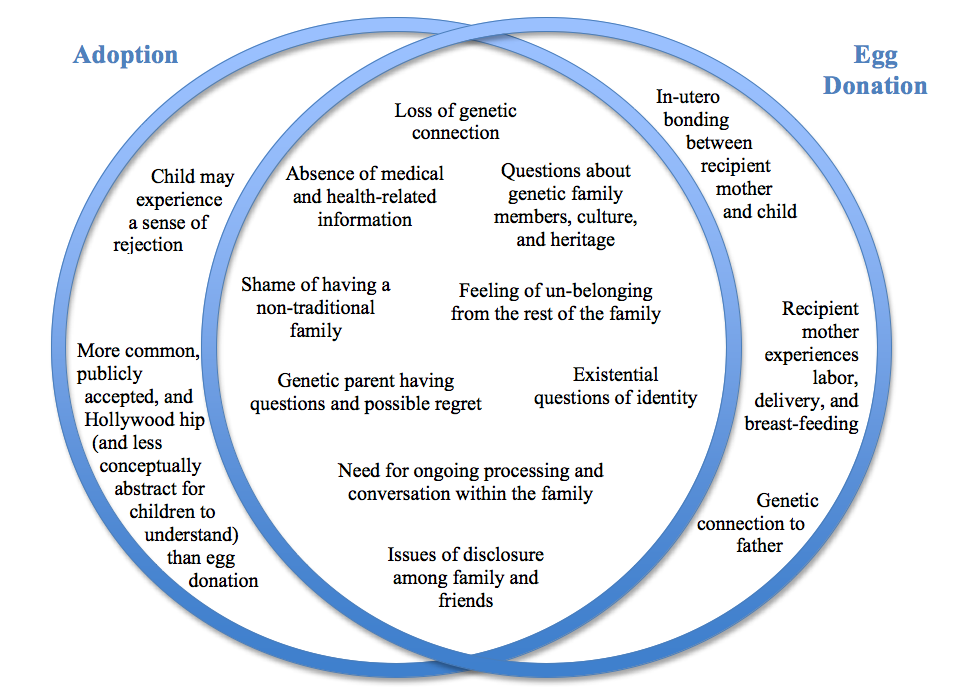
But for the mothers and children, egg donation has more psychological, social, and emotional similarities to adoption than to any other form of family building. To illustrate this further, I drew a venn diagram laying out the overlap. (Again, yes, I'm weird for doing this. Just go with it.)


Sure, there are distinctions, and yes, there's a lot missing, but I still maintain that no matter how complete this diagram gets, the similarities between egg donation and adoption are greater than the differences.

Ultimately, I think this is a linguistics issue. It's called an "egg donor procedure," and it produces an "egg donor baby," but this language places all the focus on the doctors and the donors. Yes, she's donating, but I'm receiving, and these phrases don't say anything about my experience. Come to think of it, this woman isn't even donating; she's actually charging us several thousand dollars (which I think is fair considering all the time, effort, pain, and risks). In light of all this, I can't help but feel that "egg donation" is a misnomer.

This is an "egg adoption." Egg adoption is an all-around more accurate term, and calling it anything else undercuts the emotional, social, and practical realities of the mother-child relationship. If you ignore that egg adoption is philosophically truer, I think that will just make it harder in the future when the square peg doesn't fit into the round hole.

I need to think of this as egg adoption so I can prepare myself for what I might face when raising a child that isn't genetically related to me. The adoption community has worked hard to create a culture of openness, integrity, and normalcy, and it has a deep understanding of the social and psychological implications of the process. It's obviously not exactly the same, but I'd be crazy not to learn from them if I'm going to consider this.

Yup. I said it. I'm considering this.

Weird.

Friday, July 15, 2011

Un(en)titled

I don’t deserve this.

I don’t deserve my infertility or the years I spent struggling with the most complex grief I’ve ever known. God knows, there are worse tragedies in the world, but there’s something about the pain of infertility that is deepened by its inherently enduring hopefulness. It forbids you to let go. I spent over 4 years living in monthly anticipation that something good would happen. “Don’t give up,” it said. “There’s still one more thing to try.” So I hung on. And on. And on. And I didn’t deserve that.

I also didn't deserve my generous and loving family, the education I've had, or the summer camps I went to when I was young. I don’t deserve a nice house, the means to travel, or to eat out when I want. I don’t deserve a husband who is willing to work as hard as I am at making our relationship beautiful, nor do I deserve access to the therapy that helped us get here. I don’t deserve my above average intelligence, my great health, or a face that still gets me carded at 39. I don’t deserve a lifetime of good relationships, loads of dear friends, and (in case I haven’t mentioned) my incredible family.

I didn’t deserve any of these things because deservedness has nothing to do it. You get what you get. Some things are good; some things aren’t. That’s just the way it is.

It’s a simple truth, but it didn’t occur to me until now: I'm not entitled to fertility. Being unable to conceive at 35 was a stroke of bad luck, but considering the context of the rest of my life, it seems pretty fair. I am absurdly privileged, and there is no reason that I should be able to have children on top of all the embarrassing number of advantages that I've had – advantages for which I was never even been especially grateful.

Until infertility. Infertility mocked my expectations. After my first failed IVF, infertility made me stand in line behind a pregnant woman while I bought cat food. Infertility flooded my Facebook feed with chubby cheeks and onesies while I was bled out a miscarriage. It ridiculed my grief and was indifferent to my tears. It made me want and didn’t let me get. Infertility humbled me.

I didn’t deserve infertility, but it taught me to recognize and appreciate all the privileges I never earned. I am grateful for how it’s changed me, but I still won't say that I’m grateful for infertility itself, because for fuck’s sake, it hasn’t changed me that much.

Sunday, June 12, 2011

Down Dog, Up Dog

After my second IVF, I got mad at my body. After years and years of taking amazing care of it, I was repaid with infertility at an unreasonably early age. I felt betrayed that my body would do this to me. And I was pissed.

"Listen, You," I said to my body. "Your infertility is bullshit, and you deserve to be punished. Now, I know how much you love doing yoga, but I don't care about you right now. Not to mention, doing yoga makes me feel closer to you, and that makes me feel even more vulnerable, and I feel bad enough already, so... You're grounded: no more yoga."

The punishment stuck for about a year. Well, mostly. I would occasionally cave, but for the most part, I kept to my word. And it was good. Well, maybe not exactly good, but it was fine. OK, so, not entirely fine. I did spiral a bit. And I grieved. A lot. But whatever. I said no yoga, and I meant no yoga.

And I kept my word until a few months ago. By the end of 2010, the anger was getting exhausting, and I figured it was time for me and my body to make amends. Plus I wasn't working, and I needed something to do, so I did yoga. At first a little, and then some more, and within a couple months I was practicing 5-6 days a week.

And it changed my life.

It was unexpected; I really just stood on that mat every day because I didn't have anything else going on. And it wasn't immediate, either, but after about 4 months of daily down dogs, I was altered.
I remember reading this New York Times article a while back about how meditation changes the brain. I believed it, but I never imagined what it could have felt like. Granted yoga isn't meditation -- it's meditative, which isn't the same thing -- but still, my brain was different.

A teensy part of me feels like outlining all the incredible ways that my mindset shifted, but I'm not going to. It's not anything that can be explained, anyhow. It's more of a mood. A sensation. A kind of a filter. Or maybe it's losing a filter. In any case, I'm not going to describe it.

But, it's seriously awesome.

Tuesday, April 5, 2011

Baby Blue

I went into all this infertility stuff with a wide-open heart. N and I had just gotten back together after being separated for a year, and - being more in love than ever - I felt armed and ready for a little hoop jumping. Not even just ready: when I realized that getting pregnant would require medical treatments, I was oddly excited.

Maybe it was the lessons we'd gained from therapy; I had thought that we were such a healthy couple when we first got together, and it turned out we were as damaged as any other. But we dealt with it. We worked hard. We cried, reflected, and made ourselves as vulnerable as can be, and then we came through the other side with a closeness that I didn't know was possible.

So what if we needed blood tests and hormone checks? I didn't even mind ovarian examinations, as long as I was waxed. And providing sperm samples satisfied whatever public sex fantasies we may have had, so that part was actually kinda fun - especially that we would always go to breakfast afterwards. It was all totally cool because these hoops would just make us more prepared parents.

I was wholly optimistic. In point of fact, I'd registered for this blog in 2007, but I never wrote a single post because I thought, "Well, I'm about to get pregnant, so blogging about my experience would be disrespectful to women who were really infertile."

My Zen lasted about 2.5 years.

In 2010, it started to occur to me: this actually might not happen. I might really be infertile. And that's when I started to get a little testy. Moody. Grumpy. Depressed. Despondent. Devastated. Even (and I find the words hard to type) kind of suicidal.

Which was weird because to be honest, I was kind of disgusted by women who were dramatic about their infertility. "Oh, my god. I can't get pregnant. I should just kill myself." Dude, seriously? It's a three step process: face the facts, grieve, and move on.

Well, yes, but that second step is a bitch.

Wednesday, February 16, 2011

The Seven Year Itch

The seven-year itch is real.

It doesn't always land at exactly seven years, and men don't always have flings with Marilyn Monroe, but the principle is true.

The theory is that after about 7 or 8 or 9 or 10 years, people in relationships realize two things:
  1. That thing my sweetheart does that I used to think was cute is actually really annoying, and
  2. That thing I thought I could give up for the sake of my sweetheart, I actually don't want to.
In other words, the maximum amount of time it takes for people blinded by love to regain their vision is a decade.

This tendency impressed me. Not so much that there's a relative universality to it, but rather that people can fake it for that long. And moreover, that we can live together for all that time and never realize how much of our happiness is pretense.

I learned about the seven-year itch a couple months into therapy, which was also a couple months into my break-up with N. Having gotten together in 1996 and split up in 2006, we were pretty much on schedule. This wasn't exactly good news, except that the person telling me about the Itch was a couples' therapist who was -- and please allow me to take a moment to find an accurate adjective without exaggerating ... OK, I'm going to go with -- brilliant.

But she wasn't brilliant because N and I got back together (which we did), or because our relationship is absolutely perfect in every way (which it isn't), or because of her fashion sense (four different shades of burgundy, really?).

What makes our therapist brilliant is her capacity to see through the pretenses that make us itch in the first place: the loss of self where boundaries should be, the defensiveness that replaces compassion, and the sadness underneath the armor. Our therapist makes us see the weak, vulnerable, broken mess that's buried inside ourselves. She makes us wade through the depths of our emotions. She makes us admit the secrets we keep from ourselves. And she makes us love ourselves all the same.

All this gives us something more to offer each other as partners -- something true.

So, here we are, 15 years into a relationship that I humbly call mostly wonderful. Does that mean we've skirted the second round of seven-year-itchiness? I hope so. But if not, then I at least like to think that I've bitch-slapped it a bit.